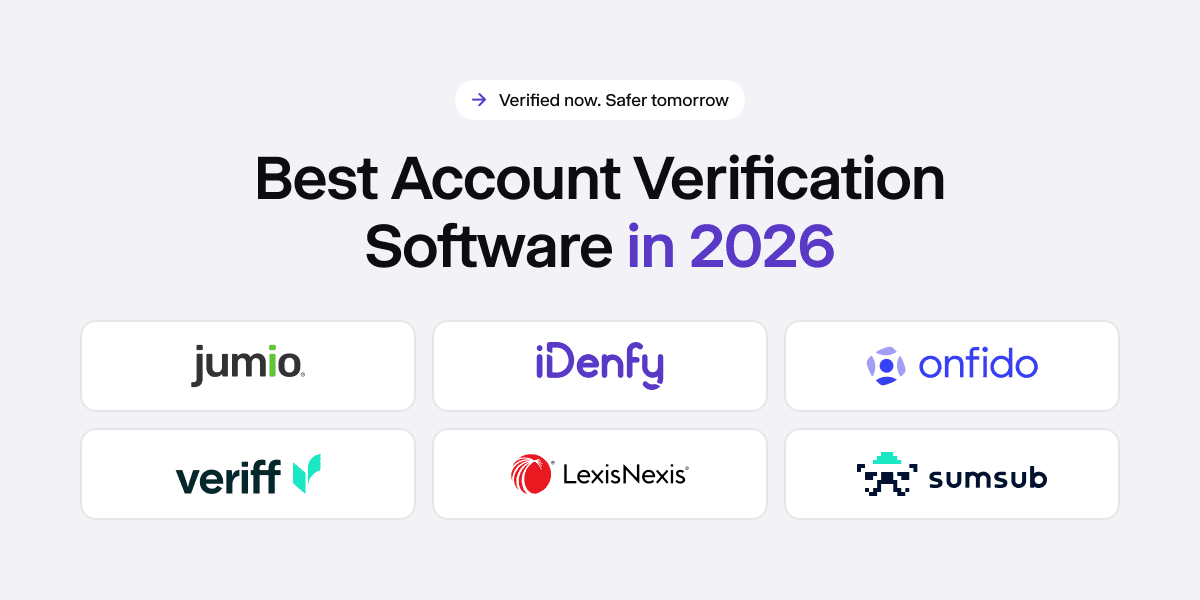
The pressure on businesses to confidently verify users has never been higher. Fraud is faster, regulations are tighter, and customer onboarding now happens almost entirely online. Whether a company is dealing with new signups, returning users, or sensitive access requests, verifying accounts properly is no longer a “nice to have” – it is the foundation of trust.
2025 has seen a surge of platforms that help businesses validate accounts with far more accuracy and far fewer manual steps. Some tools are built around biometric checks, others around document analysis, and others around ongoing monitoring. What the better ones have in common is that they confirm the person behind the account is real and authorized – without making that process feel like an obstacle.
1. iDenfy
Official Website: https://idenfy.com | Score 4.9
iDenfy holds its place at the top thanks to a combination that is surprisingly rare in this market: high accuracy and broad verification coverage. Many competitors excel in one of those areas, but iDenfy manages to hit two at once.
We give businesses a straightforward way to verify new accounts or validate returning users, whether the process involves identity checks, biometric assurance, document validation, or a mix of methods. Rather than forcing users down a rigid flow, we let companies adapt verification steps based on their risk thresholds, making it a good fit for fintech, marketplaces, gambling platforms, and online services where account integrity is very important.
A few things make us a standout:
- Facial recognition, document scanning, liveness detection, and database checks can be combined into a single flow — or stripped back to whatever actually fits the use case
- Device metadata, behavioural patterns, anomalies, and document inconsistencies are evaluated in real time, within seconds of submission
- Most verifications run automatically, but the platform routes edge cases to manual review when something needs a human to look at it
- Verification depth can be adjusted by user segment or account type — higher-value accounts get stricter checks without applying the same friction across the board
Our approach to account verification is simple: catch fraud, approve legitimate users fast, and reduce the friction between them. In 2026, that balance is what matters most, and we handle it well.
2. Sumsub

Official Website: https://www.sumsub.com | Score 4.6
Sumsub has become a common choice for businesses seeking automation, fraud checks, and flexible verification flows without stitching together multiple tools. It’s best known for KYC, but it holds up well in broader account verification too – validating new signups, securing existing accounts, and keeping an eye on ongoing activity.
What makes it work in practice is that the verification steps fit together without the process feeling rigid. It’s built for companies that need things to move quickly but don’t want to trade that speed for meaningful fraud protection.
Sumsub generally stands out for:
- Identity checks, risk scoring, and liveness validation are chained together so accounts get verified quickly without constant manual intervention
- Catches manipulated images, fake account attempts, and behavioral anomalies before they become a problem
- Verification records that hold up to regulatory requirements across multiple regions
- Flows can be adjusted by user type, risk level, or account action, which makes it workable across different industries without rebuilding from scratch
Sumsub’s appeal is straightforward, offering a practical, automation-first approach that helps businesses grow without letting unusual accounts slip through unnoticed.
3. Veriff
Official Website: https://www.veriff.com | Score 4.5
Veriff earns its place near the top on the strength of its document coverage and fraud detection accuracy. It’s the kind of platform that makes sense for companies onboarding users across multiple regions or industries, where both document variety and consistent results matter.
The verification process holds up even when users submit poor-quality images, which, in practice, happens more often than most platforms plan for. Fraud specialists and machine learning models work together to catch inconsistencies early — before a fake account gets far enough to cause a problem.
Noteworthy features include:
- High document recognition accuracy: Especially useful for global platforms needing to verify users across multiple ID formats.
- Fraud-pattern recognition: Veriff uses behavioral and metadata analytics to assess risk.
- Fast response times: Important in markets where onboarding abandonment is high.
- Useful admin controls: Companies get visibility into verification performance without complexity.
Veriff’s biggest draw is its reliability in international environments, where account verification is rarely straightforward.
4. Entrust (Onfido)
Official Website: https://www.entrust.com | Score 4.4
Entrust, formerly Onfido, suits businesses that want verification to feel as painless as possible for the end user. The interface is clean, and the platform is built with drop-off rates in mind – the goal is to get users through without them hitting a wall halfway through.
The focus is identity verification, but plenty of businesses use it specifically to confirm account authenticity during onboarding or at key moments like major account changes.
Entrust delivers value through:
- Friction-reduced verification flows: The process feels quick and intuitive, especially on mobile.
- Clear account risk evaluation: Insightful signals help companies decide whether a user should be trusted.
- Solid liveness detection: Helps catch attempts involving masks, photos, or screen replays.
- Helpful audit trails: Businesses can easily trace verification decisions.
Entrust’s strength is not in being the most complex or most layered system – it is in delivering verification that feels natural for users and reliable for businesses.
5. LexisNexis
Official Website: https://www.lexisnexis.com | Score 4.1
LexisNexis is widely known for its account verification capabilities, and instead of relying purely on biometrics or document scanning, the platform uses a wide range of data sources to validate whether a user is who they claim to be.
This approach works particularly well for businesses dealing with recurring or returning user accounts where identity intelligence matters.
LexisNexis is typically chosen for:
- Massive identity datasets: Helps detect inconsistencies that other tools may miss.
- Risk scoring: Useful for industries that need advanced account oversight.
- Fraud pattern detection: Behavioral anomalies are flagged early in the process.
- Flexible integration options: Works with a variety of platforms and onboarding systems.
LexisNexis may not offer the most modern UX, but its analytical depth makes it a trusted option for companies that need more than just surface-level account verification.
6. Jumio
Official Website: https://www.jumio.com | Score 4.1
Jumio remains one of the most recognized names in the verification world. The platform is built for companies that need thorough verification of user accounts, especially in sectors where compliance is strict and fraud attempts are constant.
One of the reasons Jumio ranks so highly is its long-running investment in biometric matching and identity assurance. The company has large datasets for training its models, which helps improve match rates for edge cases and varied document types.
Jumio typically stands out for:
- Advanced biometric matching: Strong facial similarity matching makes it a popular choice for sensitive onboarding processes.
- Validates a wide range of global IDs with consistent accuracy
- Already well-positioned for compliance audits, which is reason enough for many enterprises to choose it
- Built to handle large-scale onboarding without slowing down under volume
Jumio isn’t the most straightforward tool to configure for smaller platforms, but for enterprises that need intensive account validation, it remains a reliable default.
Conclusion
What separates the best account verification platforms from the rest is not just accuracy or speed. It is how well they help businesses balance security, user experience, and scalability.
Across the board, the providers above earn their place because they offer:
- Reliable fraud detection
- Flexible verification flows
- Clear, actionable insights
- Smooth onboarding experiences
- Tools built for real-world business scenarios
Among them, we stand out for offering the most balanced all-around solution – strong automation, predictable results, and user-friendly flows backed by deep risk intelligence.
As onboarding risks grow, investing in trustworthy account verification software is becoming one of the smartest decisions a company can make. The tools and software above continue to prove that when verification is done well, both businesses and customers benefit.