This guide compares the best age verification software providers for 2026 – covering features, pricing models, customer reviews, supported countries, integration options, and security certifications. Use it to choose the right age verification solution for your business.
Top 5 Age Verification Providers
We pulled ratings from G2, Capterra, TrustRadius, and Gartner Peer Insights for the platforms that actually come up in real procurement conversations. The average score for each provider is based on user reviews available on those platforms as of March 2026 – a dash means there were no published reviews on that particular site at the time we checked.
The market for age verification solutions has expanded fast, mostly in response to tightening regulations across the UK, EU, and increasingly, individual US states. New laws like the Online Safety Act, the Digital Services Act, and a growing patchwork of state-level requirements have pushed this from a nice-to-have into something auditors actually ask about. Most regulated businesses don’t build this in-house – they plug in a third-party age verification provider to avoid maintaining their own document libraries, liveness detection models, and audit trails. It makes sense when you look at the overhead involved.
| # | Provider | G2 | Capterra | TrustRadius | Gartner | Average |
|---|---|---|---|---|---|---|
| 1 | iDenfy | 4.9 | 4.7 | 5.0 | 4.8 | 4.85 |
| 2 | Sumsub | 4.6 | 4.7 | — | — | 4.60 |
| 3 | ID.me | 4.7 | 4.2 | 4.9 | 4.0 | 4.45 |
| 4 | Veriff | 4.3 | 4.0 | — | — | 4.15 |
| 5 | Onfido (Entrust) | 4.4 | 4.6 | 3.0 | 4.3 | 4.08 |
Whether you need to add age verification online to a high-volume e-commerce checkout, enforce age gates on an adult content platform, or gate-restrict an iGaming age verification website, the right provider will determine not just whether you pass an audit, but how much friction you add to your user flow in the process.
Top Age Verification Software Comparison (2026)
Here are the best age verification software providers ranked by key features. We compared age verification tools based on integration flexibility, verification accuracy, pricing models, compliance certifications, and AML/KYB capabilities.
| Feature | iDenfy | Sumsub | ID.me | Veriff | Onfido |
|---|---|---|---|---|---|
| Supported Countries | 200+ | 220+ | US & Canada only | 200+ | 195+ |
| API + SDK (iOS, Android, Web) | ✓ | ✓ | ✓ | ✓ | ✓ |
| iFrame Integration | ✓ | ✓ | ✓ | ✓ | ✓ |
| No-Code / 3rd-Party Plugins | ✓ (Shopify, WooCommerce, Zapier, WordPress, Bubble) | ✗ | ✗ | ✗ | ✗ |
| Manual Review (24/7) | ✓ | ✗ | ✓ | ✗ | ✓ |
| Verification Success Rate (Published) | 99.9% | Not published | Not published | 98% (automated) | Varies by country |
| AML Screening | ✓ | ✓ | ✗ | ✓ | ✓ |
| Business Verification (KYB) | ✓ | ✗ | ✗ | ✗ | ✗ |
| Reusable Digital Identity Wallet | ✗ | ✗ | ✓ | ✗ | ✗ |
| ISO 27001 Certified | ✓ | ✓ | ✓ | ✓ | ✓ |
| SOC 2 Certified | ✓ | ✓ | ✓ | ✓ | ✓ |
| Cyber / E&O Insurance | ✓ (Lloyd’s of London) | No public info | No public info | No public info | No public info |
| GDPR Compliant | ✓ | ✓ | ✓ | ✓ | ✓ |
| Pricing Model | Pay per approved | Pay per completed ($1.35/check) | Not published | Pay per completed ($1.39/check) | Pay per each check |
Notable Mentions
| # | Provider | What They’re Known For |
|---|---|---|
| 6 | Yoti | Privacy-first age verification using facial age estimation and digital ID wallets. Widely used in UK retail and online alcohol/tobacco sales. Strong compliance posture for the Online Safety Act. |
| 7 | AgeID | Specialist age verification platform backed by MindGeek, focused on adult content compliance. Provides single sign-on reusable age tokens across member sites. |
| 8 | Veridas | Biometric-first identity and age verification with voice and face recognition. Strong presence in telco and banking. Certified by NIST and iBeta for liveness detection accuracy. |
The Main Features for Age Verification Vendors
Almost every regulated business is better off integrating an established age verification solution from a dedicated provider than attempting to build equivalent infrastructure from scratch. The engineering cost, ongoing maintenance burden, and liability exposure of a self-built age verification website gate are rarely justified.
These are the most essential features, tips, and considerations we evaluate across age verification providers:
Integration Choices
Age verification touches every onboarding surface – alcohol sales, adult platforms, iGaming, tobacco – so it has to fit wherever users show up. Most vendors cover the basics: dashboard-generated links, API, iFrame, SDK for iOS and Android. Where things actually diverge is whether they’ve built connectors for the platforms non-technical teams use. Shopify, WooCommerce, WordPress, Bubble, Zapier – if those are in your stack, confirm support before you get too far into an evaluation.
- Recommendation: For teams without a developer, the integration method is everything. A Shopify or WooCommerce plugin that goes live in an afternoon is a different proposition from an API integration that needs two sprint cycles. White-label customization is another one to clarify upfront – some vendors include it, others price it separately, and it’s rarely clear from the website.
- Regulated Business: Before committing to an integration method, confirm it can produce audit-ready records in the format your regulator expects. Some authorities want session-level evidence of the check – not just a pass/fail flag in your database.
- High-Risk Business: For iGaming or adult content, SDK-level integrations with device-binding are harder to work around than iFrame embeds. Worth knowing before you finalize the architecture.
Accuracy of Age Verification
If a vendor can’t guarantee accurate OCR extraction of the date of birth from an ID document, that becomes a compliance problem quickly. The verification success rate tells you how accurately a platform processes real documents and catches fraudulent ones. KYC vendors can utilize an additional 24/7 manual review to maximize success and approval rates.
- Recommendation: Ask vendors exactly how they define their success rate before taking the number at face value. A “98% automation rate” and a “99.9% verification success rate” measure completely different things. Also, find out whether poor-image-quality denials count against your charges – the answer changes the real cost significantly.
- Regulated Business: Auditors are increasingly asking for accurate data broken down by document type and country, not just a headline figure. A vendor who can’t provide that breakdown is going to create problems when an audit comes around.
- High-Risk Business: For gambling or adult content, a false negative – a real underage user getting through – is a worse outcome than a false positive. Platforms in those categories should prioritize vendors with a human review fallback layer.
Age Verification Laws by Country and US State
The regulatory picture on age verification changes faster than most compliance teams can track, so treat what follows as a snapshot. A compliance attorney who knows your specific markets should have the final word.
The UK moved first in a meaningful way. Ofcom’s enforcement under the Online Safety Act – which came into full effect in October 2025 — ruled out self-declaration and checkbox consent. Photo-ID scanning or credit card verification is the floor now. Fines go up to £18 million or 10% of global turnover, so the stakes for large platforms are real.
In the US, there’s still no federal law, which has left individual states writing their own. Louisiana got there in 2023. Florida passed requirements with specific technical standards for verification methods. Utah extended requirements to social media platforms. Virginia puts liability on the platform itself if a minor gains access. The result: platforms operating nationally are dealing with several overlapping requirements that weren’t written to be consistent with each other.
The EU adds two parallel frameworks. The Digital Services Act targets very large platforms and requires risk-based protections against minor exposure to harmful content. GDPR applies separately – parental consent for processing under-16 data is required, though the exact age threshold varies by member state (it’s not the same across the bloc). Australia’s eSafety Commissioner has enforcement powers over explicit material, but the implementation details were still being finalized as of late 2025.
Recommendation: For vendor selection, what matters most is that “supports [country]” in a marketing document doesn’t tell you whether the vendor’s verification method is actually sufficient under that country’s law. A few regulators have already specified which methods don’t qualify. Ask vendors directly what methods they support in your key markets and whether those methods meet current regulatory requirements — not just whether the country appears in their list.
Pricing Models
Age verification software is priced in three main ways, and the difference matters more than most people expect when they first run the numbers:
- Pay per ID verification – The service provider will charge for each attempt, meaning it will be charged if identity verification is approved, denied, canceled, or unfinished.
- Pay per completed ID verification – The service provider will charge only when verification is complete, meaning it will be charged regardless of whether the identity verification is approved or denied.
- Pay per approved ID verification – The service provider will charge only when verification is finished and approved. This is the most buyer-friendly model, as you are not charged for user drop-offs or failed attempts.
Recommendation: Because users often fail on the first attempt – bad lighting, expired document, camera issue – a pay-per-approved model can end up significantly cheaper than the per-attempt or per-completed alternatives, even if the per-unit rate looks nominally similar. Ask any vendor you’re seriously evaluating to run a cost simulation based on your expected monthly volume and a realistic failure rate estimate.
Fitting into Other Compliance Procedures
Here’s something that catches buyers off guard: age verification doesn’t sit outside your compliance stack, it’s part of it. The vendor you pick here will either connect cleanly with AML screening, KYB, and audit workflows – or create friction every time a regulator asks for documentation. You should verify whether the age verification software provider is GDPR compliant and holds ISO 27001 certification.
- Recommendation: AML, KYB, sanctions screening – if any of those are on a realistic horizon for your business, it’s cheaper to pick a vendor that offers them as add-ons now than to migrate platforms in 18 months. Platform migrations in this space are genuinely disruptive.
- High-Risk Business: Cyber insurance and Technology coverage are uncommon in this market. If a vendor carries it — underwritten by something real, like Lloyd’s of London – that shifts the risk picture on a system failure or breach.
If you’re running verification across multiple surfaces – web, mobile, marketplace – you want one integration, one API, one audit trail. Separate implementations per channel create logging inconsistencies that tend to surface exactly when you don’t want them to, which is during an audit. The best age verification providers will expose one API that handles document scanning, liveness detection, and result delivery consistently, regardless of where the user is onboarding.
#1 iDenfy
4.85 Average Score · (4.7 Capterra | 4.9 G2 | 5.0 TrustRadius | 4.8 Gartner)
iDenfy website: idenfy.com
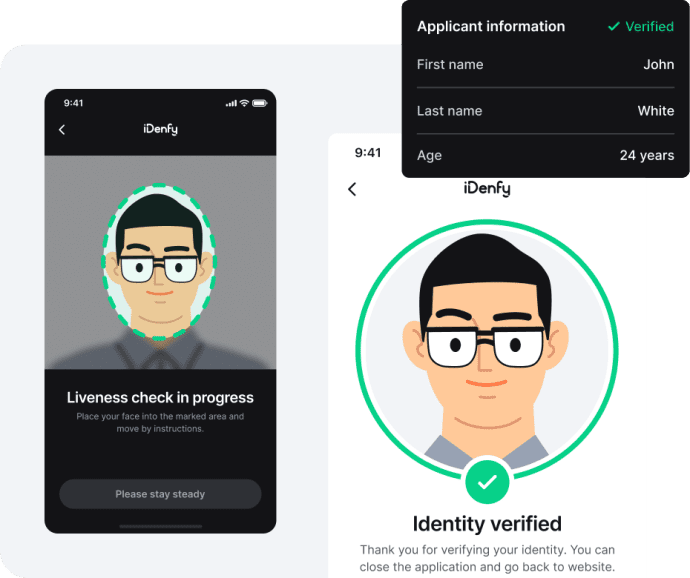
iDenfy tops the list. The platform covers identity verification, KYB, and AML without separate contracts – useful if you want to avoid stitching together vendor relationships as your compliance surface grows. On age verification: 200+ countries and territories, a 99.9% success rate that’s published rather than implied, and a 24/7 human review team sitting behind the automated layer. Every session, the AI flags get a human look. That’s what holds the number where it is across such a wide range of document types. Pricing is pay-per-approved – failed attempts and abandoned sessions don’t generate charges. Deployment options range from the Magic Link no-code builder (zero engineering required) through full API, SDK, iFrame, and native plugins for Shopify, WooCommerce, WordPress, Bubble, Zapier, and Magento.
Integration Choices
- iFrame, Dashboard, and mobile SDKs with white-label customization;
- No-code Magic Link builder – no engineering required;
- Native plugins for Shopify, WooCommerce, WordPress, Bubble, Zapier, Magento;
Accuracy of Age Verification
- 99.9% verification success rate across documents from 200+ countries;
- 24/7 manual moderation team as a second review layer;
- Automated AI document analysis with MRZ scanning for date-of-birth extraction;
Costs per Age Verification Check
- Pay per approved ID verification (not charged for denied or abandoned sessions);
- Pay per completed ID verification is also available.
Fitting into Other Compliance Procedures
- AML screening (sanctions, PEPs, adverse media) available as an add-on post-verification;
- Know Your Business (KYB) solution available;
- Utility bill / Proof of Address verification available;
Security and Compliance
- ISO 27001 certified (certificate no. TIC 1512120135);
- SOC 2 certified;
- ETSI 119 461-1 certified for remote identity proofing;
- GDPR compliant;
- Cyber insurance and Technology Errors & Omissions (E&O) coverage by Lloyd’s of London Coverholder;
Customers Say
The 4.9 on G2 stands out – compliance tools don’t usually score that high because the buyers tend to be people who’ve been burned before. Going through reviews across platforms, the consistent themes are: setup is genuinely easy (not just easy-for-a-compliance-tool), support responds quickly (this comes up more than anything else), and the pay-per-approved pricing produces noticeably lower costs than what reviewers paid under per-attempt models elsewhere.
The setup experience and documentation are described as well-structured and clear enough that teams without compliance backgrounds can get through the initial integration without a lot of back-and-forth. Support gets called out repeatedly – not just as “good,” but fast and problem-solving in a way reviewers contrast with other vendors they’ve used before. On the functionality side, mobile SDK customization comes up from teams who needed to fit iDenfy into an existing app UX without rebuilding the whole flow. The API flexibility is mentioned by developers across different backend stacks as straightforward to work with. Shopify retailers and blockchain-based businesses specifically mention the integration worked cleanly. Regulated businesses in fintech and iGaming point to the AML screening and audit trail as deciding factors – having it all in one platform rather than sourcing a separate AML vendor was part of their decision. The pay-per-approved model draws consistent praise: multiple reviewers calculated what they saved after switching from per-attempt billing and describe it as significant.
The thing that comes up negatively, when anything does: getting the verification UI exactly on-brand takes a few back-and-forths. Nobody describes it as a dealbreaker.
#2 Sumsub
4.60 Average Score · (4.7 Capterra | 4.6 G2 | No reviews on TrustRadius)
Sumsub website: www.sumsub.com
Sumsub handles more than 50,000 verifications a day across 220+ countries – breadth that few platforms match. The main reason it comes up in evaluations is that coverage, combined with a workflow builder that lets product teams configure country – or risk-tier-specific flows without pulling in developers each time something changes. Integration documentation is solid, and processing speeds at high volume get good marks. Where reviewers push back is on pricing ($1.35 per completed check as of October 2025, including denied sessions) and support – enterprise clients generally describe responsive, dedicated help, but smaller accounts get more mixed results. There’s no public accuracy disclosure and no advertised 24/7 human review, so visibility into what happens when the automated system hits a difficult document type or region is limited.
Integration Choices
- iFrame, Dashboard, and mobile SDKs with white-label customization;
Accuracy of Age Verification
- No publicly advertised 24/7 human manual review service;
Costs per Age Verification Check
- Pay per completed verification – $1.35 USD per check as of October 2025;
- Denied verifications (due to poor image quality or expired documents) are charged;
Fitting into Other Compliance Procedures
- AML screening (sanctions, PEPs, adverse media) is available;
Security and Compliance
- ISO 27001 certified;
- SOC 2 certified;
- GDPR compliant;
Customers Say
Sumsub averages 4.6 across G2 and Capterra. The workflow builder is the thing reviewers mention most – configuring different flows per country or risk tier without a developer involved for every change is genuinely valued by product teams handling complex onboarding across multiple markets. Global document coverage comes up frequently too, particularly from businesses that have hit dead ends with other platforms for certain regions or document types. Processing speed at high volume gets good marks in fintech and iGaming contexts.
Pricing is where the conversation shifts. The $1.35/check rate – denied sessions included – becomes a real line item once verification volume climbs. A few reviewers describe it as reasonable at first and then increasingly hard to justify at scale. Support is the other split: enterprise accounts describe it as responsive and dedicated; smaller customers mention slower resolution times and less proactive help. Developer documentation scores well, but non-technical teams find the onboarding steeper than platforms that offer no-code options.
#3 ID.me

4.45 Average Score · (4.2 Capterra | 4.7 G2 | 4.9 TrustRadius | 4.0 Gartner)
ID.me website: www.id.me
ID.me’s track record comes from powering identity verification for US government agencies – the IRS, the VA, state employment portals – and the FedRAMP authorization reflects that history. The reusable digital identity wallet is the feature that sets it apart: verified once, users can authenticate across any ID.me-connected service without resubmitting documents. That’s genuinely useful for businesses with returning customers who hit multiple touchpoints. The hard limit is geography – US and Canada only, full stop. No amount of enterprise negotiation changes that. If any portion of your user base is outside those two markets, ID.me won’t work for them. The analytics dashboard also draws complaints; it covers the basics but lacks the depth that teams tracking drop-off rates and verification outcomes tend to want.
Integration Choices
- iFrame, Dashboard, and direct digital wallet app integration;
- No publicly listed no-code builder for custom flows;
Accuracy of Age Verification
- Accuracy statistics are not publicly disclosed;
- Hybrid verification system (automated + human supervision) available;
- 3D Active Liveness Detection supported;
Costs per Age Verification Check
- Pay per completed verification – specific pricing not published. Contact ID.me directly;
Fitting into Other Compliance Procedures
- AML screening is not offered;
- Business verification (KYB) is not offered;
- Cross-match with US government databases supported;
Security and Compliance
- ISO 27001 certified;
- SOC 2 certified;
- GDPR compliant (for US/Canada operations);
- FedRAMP authorized for US government use cases;
Customers Say
ID.me averages 4.45 across the platforms where reviews exist. The setup experience gets consistent praise – reviewers describe adjusting product groups, toggling verification gates, and targeting specific user segments (military, healthcare, teachers) as fast and requiring minimal configuration. Shopify integration in particular comes up from retail businesses as clean and quick to deploy. The reusable wallet is the feature people are most enthusiastic about: returning users don’t re-verify, and several reviewers describe this as meaningfully improving conversion on repeat purchases. Support gets positive mentions too – a few reviewers specifically note access to a dedicated contact who proactively surfaces new use cases.
Two structural issues come up consistently. The US and Canada coverage limit is the most common complaint by a clear margin – multiple reviewers say it was the constraint that prevented them rolling out verification internationally. The analytics dashboard is the other recurring frustration: teams that want granular outcome data tend to find workarounds because the built-in reporting doesn’t go deep enough.
#4 Veriff
4.15 Average Score · (4.0 Capterra | 4.3 G2 | No reviews on TrustRadius)
Veriff website: www.veriff.com
Veriff covers 12,000+ identity documents, including non-Latin scripts – Arabic, Cyrillic, Chinese, Korean, Japanese. That document library depth is the main reason it shows up in evaluations where international user diversity is the primary concern. The platform runs on AI automation with a stated 98% check automation rate and passive liveness detection. There’s no publicly available manual review fallback. At $1.39 per completed check – including denied checks – it’s the highest published per-unit rate among the providers listed here. Multiple reviewers describe the pricing as high relative to what newer platforms offer. Support is a recurring complaint from smaller accounts, and some reviews call out the UI as less polished compared to more recent entrants.
Integration Choices
- iFrame, Dashboard, and mobile SDKs with white-label customization;
- Third-party plugin integrations are not publicly listed – contact Veriff directly;
Accuracy of Age Verification
- 98% automation rate (AI-powered);
- Passive Liveness Detection supported;
- No publicly available 24/7 human manual review service;
Costs per Age Verification Check
- Pay per completed verification – $1.39 USD per check as of October 2025;
- Denied verifications are charged at the same rate;
Fitting into Other Compliance Procedures
- AML screening (sanctions, PEPs, adverse media) is available;
- Business verification (KYB) is not offered;
Security and Compliance
- ISO 27001 certified;
- SOC 2 certified;
- GDPR compliant;
Customers Say
Reviews for Veriff land in a fairly consistent place: strong on the technical side, with recurring complaints about support and cost. Developers working on the integration describe the SDK and API documentation as solid and the initial setup as quick to get through. The 12,000+ document library – particularly non-Latin script support – comes up repeatedly from businesses serving users across regions where other platforms hit gaps. Verification speed is the other thing that gets called out positively, especially from products where the age gate decision affects a real-time user flow.
The friction shows up on two fronts. Reaching support is a common complaint, especially for accounts without dedicated management – multiple reviewers describe slow response times and difficulty escalating. Pricing is the other one: $1.39 per completed check, denied sessions included, is described in several G2 and Capterra reviews as high relative to what newer platforms charge for similar functionality. Some reviewers also flag the UI as feeling less refined than more recent entrants, though that’s more of a secondary concern compared to the support and pricing issues.
#5 Onfido (Entrust)
4.08 Average Score · (4.6 Capterra | 4.4 G2 | 3.0 TrustRadius | 4.3 Gartner)
Onfido website: www.onfido.com
Onfido, now under Entrust after the April 2024 acquisition, combines document verification, facial recognition, and biometrics in a platform that’s well-regarded for compliance alignment. The Workflow Studio – a no-code flow builder for KYC and age verification – is the feature compliance teams cite most often. It lets you adjust verification logic by market without engineering involvement each time a regulation changes, which matters at scale. Accuracy figures are published per region on the website, which is more transparent than most competitors provide – though it also makes side-by-side comparison harder. Pricing is quote-based and per-attempt: failed and abandoned sessions both add to the bill. The TrustRadius score of 3.0 sits notably below the others and warrants a closer read of recent reviews before you commit.
Integration Choices
- iFrame, Dashboard, and mobile SDKs with white-label customization;
- Workflow Studio for no-code flow configuration (compliance-focused);
- Third-party plugin integrations are not publicly listed – contact Onfido directly;
Accuracy of Age Verification
- Accuracy varies by document issue country – published on their website per region;
- Hybrid ID verification system (automated + human supervision);
- Both Passive and 3D Active Liveness Detection supported;
Costs per Age Verification Check
- Pay per each verification attempt (including denied and abandoned sessions);
- Specific pricing is quote-based – contact Onfido directly;
Fitting into Other Compliance Procedures
- AML screening (sanctions, PEPs, adverse media) is available;
- Business verification (KYB) is not offered;
- Cross-match with government databases supported in select countries;
Security and Compliance
- ISO 27001 certified;
- SOC 2 certified;
- GDPR compliant;
Customers Say
Onfido’s review picture is generally positive, with the clearest signal coming from compliance-led teams. The Workflow Studio keeps coming up – reviewers in regulated industries specifically cite it as the reason they can adjust verification logic per market without waiting on engineering each time a regulation changes. Interface design and integration quality get good marks; the overall experience is described as polished compared to older platforms in the category. Speed is the other consistent positive: fast processing is what real-time age gate products actually need.
Two things pull the scores down. One is false rejections – documents from certain regions triggering incorrect denials comes up enough in reviews that it reads as a pattern rather than an edge case. The other is pricing: quote-based, pay-per-attempt, with no published tiers. Reviewers ask for more transparency and a self-serve option more than once. The 3.0 on TrustRadius is worth looking at separately before deciding – it’s considerably below the scores on other platforms and the recent reviews there tell a slightly different story.
DISCLAIMER
This information is collected from public sources and vendor websites; it is not our final verdict or opinion. The information, in some cases, could be outdated. You should contact the vendor directly to get recent information. If there is missing information, please contact the website owner.