This guide is for: compliance officers, founders, and C-level executives comparing identity verification software across providers. Specifically, this guide evaluates platforms based on ID document verification, facial matching, liveness detection, accuracy, fraud prevention, user onboarding experience and other features.
This guide is not for: buying a service right off the page. If you need software to try right now, read our ID verification software page instead. Or, if you operate in a heavily regulated market and need PEP screening, sanctions, continuous watchlists, or business verification, read our guide to the Best KYC Software Providers.
Editor’s Note & Methodology Disclosure:
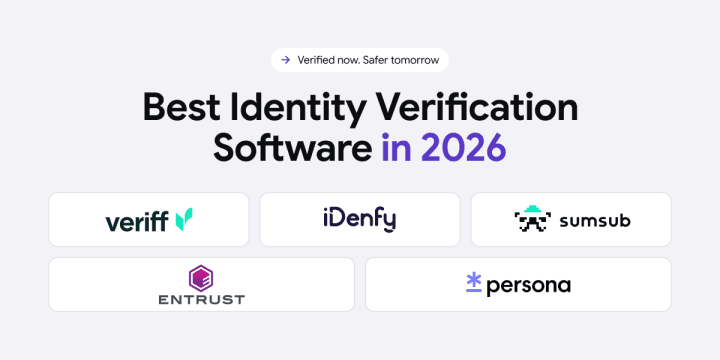
As an identity verification software provider, we analysed our last 1,352 sales calls to identify the key features and ID verification software providers that potential customers evaluate most often. From those calls, we picked the top five providers to build this comparative list. Since iDenfy was assessed in every call, our platform is included as well. In short, this data is shared openly so you can weigh each ID verification software against your own needs.
Best Identity Verification Software Providers
What is the best identity verification provider? No single identity verification software fits every business. For example, what works for a high-volume fintech can be overkill for a smaller marketplace, and a tool built for crypto’s risk profile won’t necessarily map onto fintech, e-commerce, or iGaming. So, instead of asking which provider is best overall, the smarter question is which one fits your own use case.
Below, we break down how the top providers compare, and then show you how to work out which one’s right for you.
Best Identity Verification Software: Comparative Overview
Document Coverage and Biometric Verification
| Feature | iDenfy | Sumsub | Onfido | Veriff | Persona |
|---|---|---|---|---|---|
| Physical ID document types | 16,000+ | 14,000+ | 2,500+ | 12,500+ | 3,000+ |
| Countries / territories | 230 | 220 | 195 | 230 | 200 |
| Digital ID systems | 60+ digital and mobile-based IDs | eID and non-document national methods | Not available | Not available | Digital IDs |
| Known-face detection | Selfie and document-face duplicate detection | Face Matches across applicants and ID portraits | Known Faces report | CrossLinks and biometric duplicate detection | Known-face detection |
| Customer face blocklist | Selfie and document-face blocklists | Applicant blocklist linked through biometrics | Not available | FaceBlock | Face Lists with bulk import |
| Facial matching | Selfie-to-ID and authentication | Selfie-to-ID and authentication | Photo, video or motion-to-ID | Document + selfie and authentication | Selfie-to-ID |
| Liveness detection | 3D facial motion liveness and photo passive liveness | 3D mapping and spoof detection | Photo, video and motion liveness | Integrated selfie/video liveness | Ensemble-based selfie liveness |
Scroll sideways on mobile to see all five providers. The feature column and header row stay pinned in place.
Fraud Prevention, Support and Compliance
| Feature | iDenfy | Sumsub | Onfido | Veriff | Persona |
|---|---|---|---|---|---|
| User experience | Real-time framing; too close/far controls
| Position-aware capture; distance detail limited
| Smart Capture positioning & quality guidance
| Guided positioning; near/far logic less public
| Explicit too-close/far guidance
|
| Fraud-prevention signals | Document, biometric, duplicate, blocklist, IP/proxy, device, phone and email signals with configurable risk scoring | Broad device, network, behavioral, applicant-linking and transaction signals with fraud-network detection | Document, biometric, device and repeat-attempt signals with advanced workflow orchestration | Device, network, behavioral, velocity and cross-session intelligence through CrossLinks | 50+ behavioral, device, network and visual signals with Graph and customer-controlled decisioning |
| Government database cross-checks | US AAMVA, EU, US, UK national registries, TIN, US nationwide criminal background check | Credit, utility, court and telco sources | Credit, voting and telco sources | Credit, utility and phone registries through Metadata Database Verification | US AAMVA, eCBSV, carrier, Serpro, TIN and international databases |
| Supported verification-flow languages | 36 | 56 | 44 | 46 | 41 |
| Support channels | Service deskDashboard chatAccount managerDedicated Slack | Service deskDashboard chatAccount manager | Service deskAccount manager | Service deskAccount manager | Service deskDashboard chatAccount manager |
| Security certifications | ISO 27001SOC 2 Type IIETSI TS 119 461 | ISO 27001SOC 2 Type IIPCI DSS | ISO 27001SOC 2 Type IIETSI TS 119 461 | ISO 27001SOC 2 Type IIUK DIATF | ISO 27001SOC 2 Type IIKantaraFedRAMPPCI DSS |
Scroll sideways on mobile to see all five providers. The feature column and header row stay pinned in place.
Notable Mentions
| Provider | What They’re Known For |
|---|---|
| Jumio | AI-powered identity verification with continuous monitoring and a strong enterprise footprint. Trusted by major financial institutions and airlines for high-volume, high-stakes onboarding. |
| Shufti Pro | Excels at fast automated user onboarding across more than 240 countries and territories using AI-driven document and biometric checks. |
| Trulioo | Database-first identity verification covering 5B+ people across 195 countries. Strong in data-matching and electronic ID checks – useful where document uploads aren’t practical or required. |
| IDnow | High-assurance identity verification, strict regulatory compliance, and expert-led video identification, specifically serving European financial institutions, crypto platforms, and telecom companies. |
| Socure | AI-powered identity verification built for enterprise financial services. Known for low false positive rates, real-time fraud decisioning, and integration with US financial institution data. Strong fit for banks, credit unions, and fintech lenders. |
| Lexis Nexis | Best for large enterprises, financial institutions, and government agencies requiring high-volume fraud prevention and deep data-linking capabilities. It excels at cross-referencing vast public and proprietary consumer data records rather than simple, low-cost ID checks. |
| Stripe Identity | Best for global user verification, fraud prevention, and marketplace trust. It is ideal for online businesses that need to check government IDs, match real-time selfies, and block bad actors without building custom security systems. |
Best Identity Verification Software Comparison (2026)
Here are the best identity verification software providers’ cons and pros. The cons and pros evaluation covers what shows up in real procurement decisions.
iDenfy
Public reviews by customers: (4.7 Capterra | 4.9 G2 | 5.0 TrustRadius | 4.8 Gartner)
iDenfy website: iDenfy
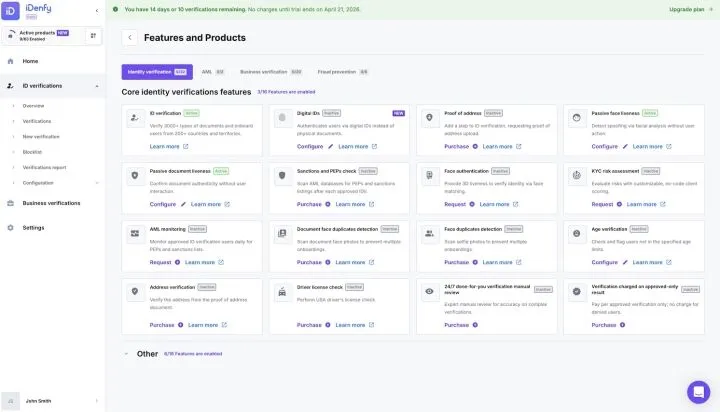
iDenfy is an identity verification provider offering document checks, biometric checks, liveness detection, duplicate-face detection, fraud-prevention signals, age assurance, electronic identity verification, and manual review.
In addition, the platform supports identity documents from a wide range of countries and combines automated decisions with 24/7 human review for cases that need a closer look.
Pros
- A pricing model that’s unusual in this space: you pay for approved verifications, not the fraudulent or failed attempts you reject – which keeps costs predictable as you scale.
- No “enterprise-only” gatekeeping. Even small companies on a pay-as-you-go plan get the full toolkit – white-labelling, the complete suite of verification and anti-fraud tools, and features that other providers reserve for enterprise contracts. Meanwhile, larger companies running high volumes of verifications get discounted pricing.
- Automated identity verification supported by 24/7 manual review
- Duplicate-face and document-face detection
- Customer-controlled face and identity blocklists
- Direct AAMVA driving licence validation and criminal background checks in US
- Facial age estimation from selfie and document-based age verification
- Full white-label options
- Wide integration choice, including API, MCP, web flow, mobile SDKs, magic links, and e-commerce plugins (Shopify, Salesforce, Magento, BigCommerce, WordPress, WooCommerce, Zapier)
- European identity-proofing and security certifications
Cons
- Smaller brand footprint than the household names on this list
- No Pay-Per-Use option, only Pay-As-You-Go or annual subscription.
- Unused prepaid verification credits don’t carry over to the next year unless you purchase a new package or deposit.
- No non-US background checks: criminal background checks and some database validations (SSN, DMV) are limited to the US market only, with no equivalent for other regions.
- Public documentation provides less detail about behavioral fraud signals than other ID verification providers.
- The standard applicant-interface language catalogue is smaller than of Sumsub and Veriff
- Some advanced checks are sold as separate add-ons
- Its international non-document database coverage may be narrower than that of providers with larger global database catalogues
- Buyers should confirm which fraud signals and regional checks are included in their selected package
Best Suited For
- Fintech and payment companies
- Cryptocurrency platforms
- Online gaming and gambling operators
- Lending businesses
- Online marketplaces
- Telecommunications providers
- Age-restricted platforms
- Regulated digital services
- European businesses requiring high-assurance remote onboarding
- Companies that value manual-review support alongside automation
Best Identity Verification Use Cases
- New customer onboarding
- Selfie-to-ID face matching
- Liveness and deepfake-attack prevention
- Duplicate-account detection
- Face and identity blocklisting
- AAMVA driving licence validation
- Electronic identity verification
- NFC passport and identity-card verification
- Proof-of-address verification
- Facial age estimation
- Returning-user biometric authentication
Pricing Model
- Pay per approved ID verification (primary model – not charged for denials or drop-offs);
- Pay per completed ID verification also available;
Overall assessment
In short, iDenfy is a strong option for businesses that want a flexible identity verification platform combining automated document and biometric checks with manual review. Its main strengths are broad verification coverage, dedicated duplicate and blocklist controls, European identity-proofing assurance, and a wide range of integration methods.
However, it may be less suitable for companies whose main priority is deep behavioral analytics or the largest possible cross-customer fraud network.
What Customers Say
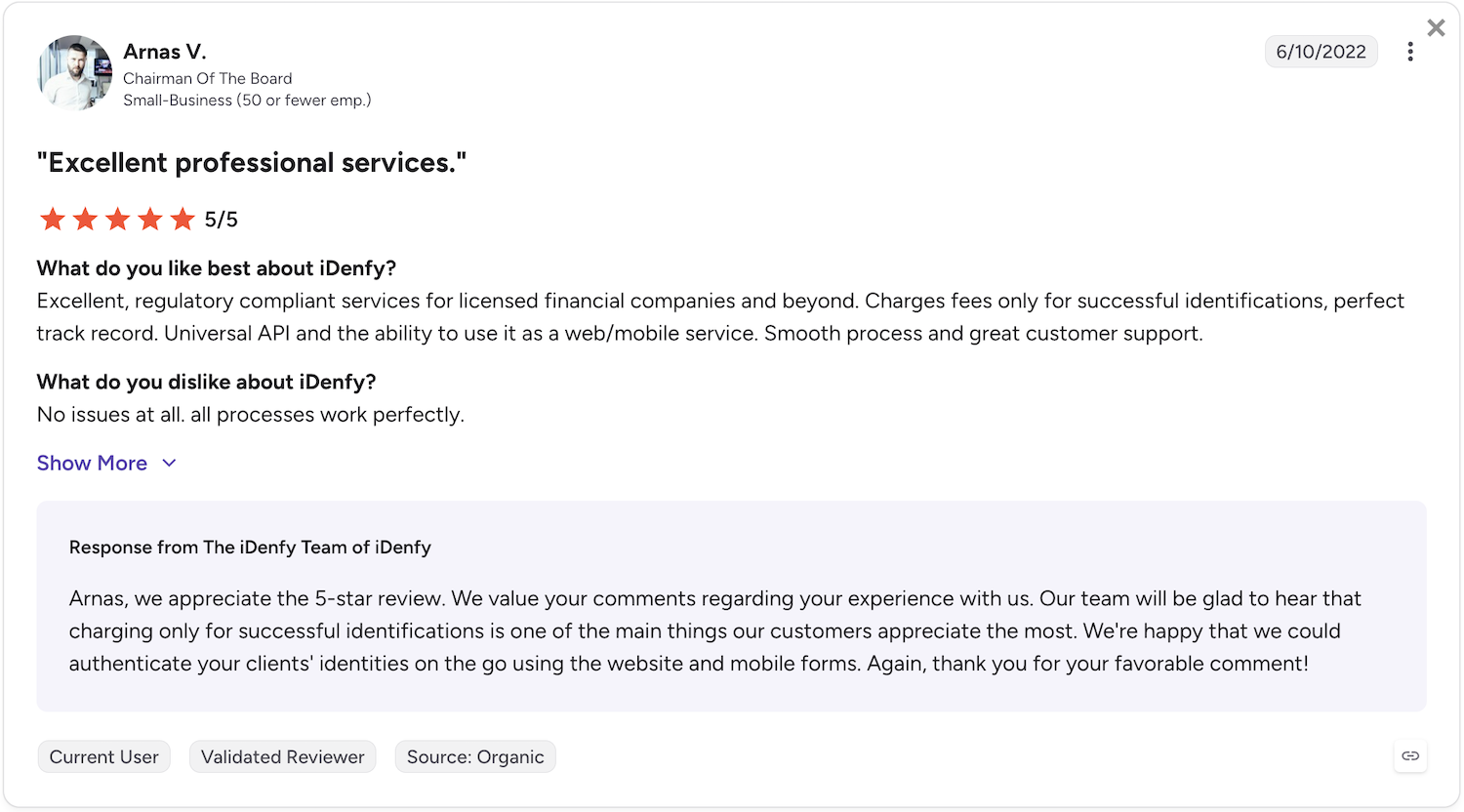
In fact, a 4.9 on G2 is unusual for compliance tooling – the buyers in this category have typically been burned before and rate accordingly. What comes up across multiple platforms: setup takes less time than expected, support actually resolves issues rather than routing them, and the pay-per-approved model delivers cost savings that reviewers specifically contrast with their prior per-attempt vendors.
In addition, reviewers describe the documentation as accessible enough that teams without a dedicated compliance engineer get through the integration without extended back-and-forth. Support comes up more than any other feature – not just as a rating, but with specific callouts: fast to respond, actually solves the problem, noticeably better than previous vendors. Developers on different backend stacks call the API clean and well-documented. Mobile SDK customization gets mentioned by teams that needed the verification flow to fit inside an existing app without rebuilding around it.
Source G2.com
Sumsub
Public reviews by customers: (4.7 Capterra | 4.6 G2 | 4.7 TrustRadius | 4.7 Gartner)
Sumsub website: www.sumsub.com
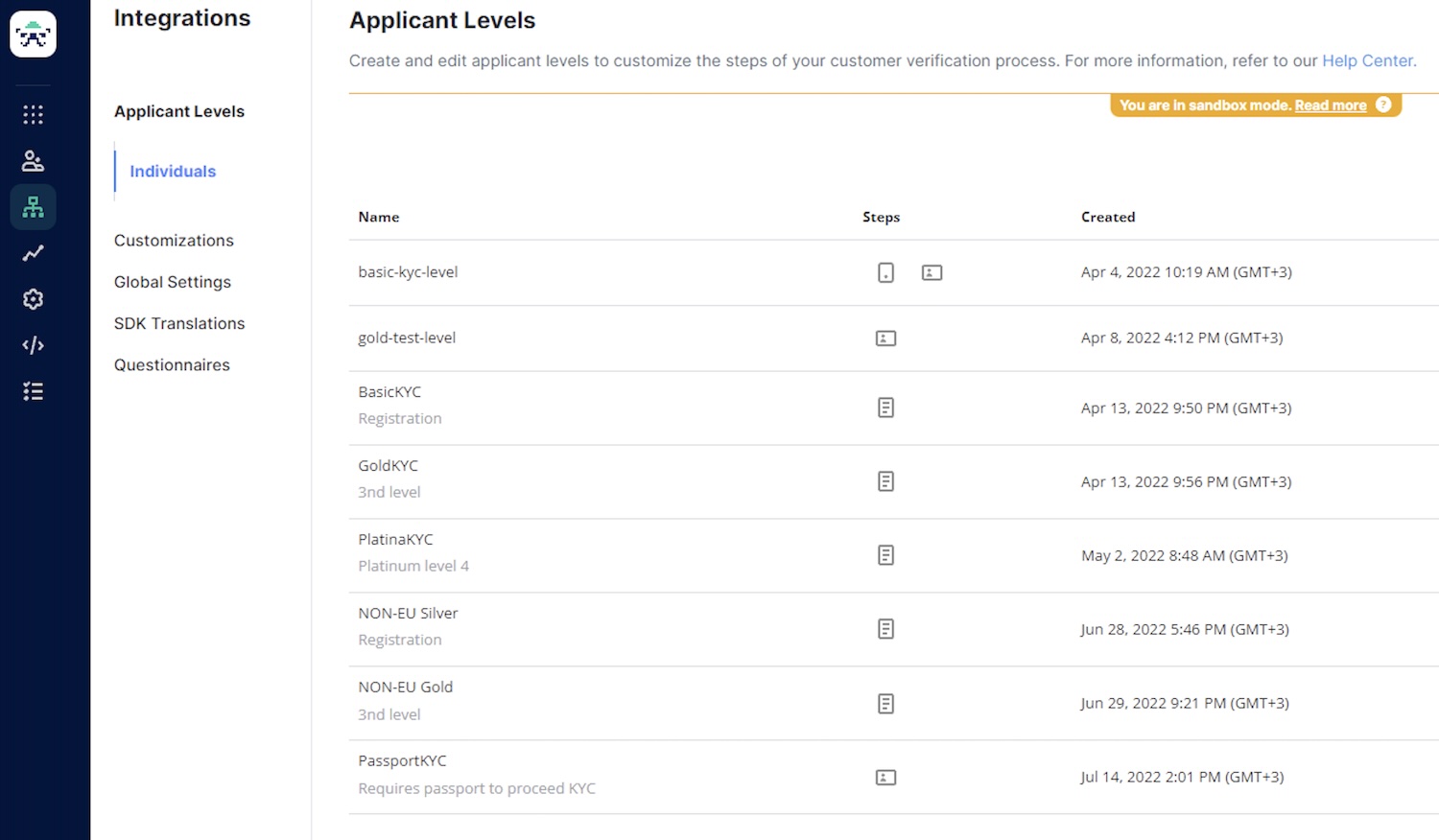
Sumsub is an identity verification and fraud-prevention platform. Its core product combines ID document checks, selfie checks, liveness, device intelligence, database checks, applicant linking, and flexible verification workflows.
As a result, the platform supports both first-time onboarding and repeat identity checks throughout the customer lifecycle.
Pros
- Strong identity-document verification and biometric matching
- Advanced liveness and spoof-detection capabilities
- Extensive device, IP, network, and behavioral signals
- Strong applicant-linking and fraud-network detection
- Duplicate-face, document, device, phone, email, and IP analysis
- Broad regional data-residency options
- Large catalogue of applicant-interface languages
- Flexible workflow builder and step-up verification
Cons
- The wide product range may make implementation more complex
- Identity verification, device intelligence, fraud-network detection, and other capabilities may be packaged separately
- Buyers should confirm exactly which fraud signals are included in the proposed plan
- Complex workflows can increase onboarding friction when not carefully configured
- May be more extensive than smaller businesses require for a standard ID verification flow
Pricing Model
- Pay per completed verification;
Best Suited For
- Fintech companies
- Cryptocurrency exchanges
- Online gaming and gambling businesses
- Payment companies and digital banks
- Remittance providers
- High-volume consumer platforms
- Businesses experiencing coordinated identity fraud
- Companies operating across many countries and regions
Best Identity Verification Use Cases
- Multi-accounting detection
- Fraud-ring and linked-applicant detection
- Device and network risk assessment
- Non-document database verification
- High-volume customer onboarding
- Regional verification workflows
Overall assessment
In short, Sumsub is best suited to companies that want a broad identity verification platform with strong fraud intelligence around onboarding. Its biggest advantage is the ability to combine documents, biometrics, devices, networks, applicant relationships, and outside databases in one verification decision.
However, the trade-off is complexity: buyers with a simple document-and-selfie use case may not need the full platform.
What Customers Say
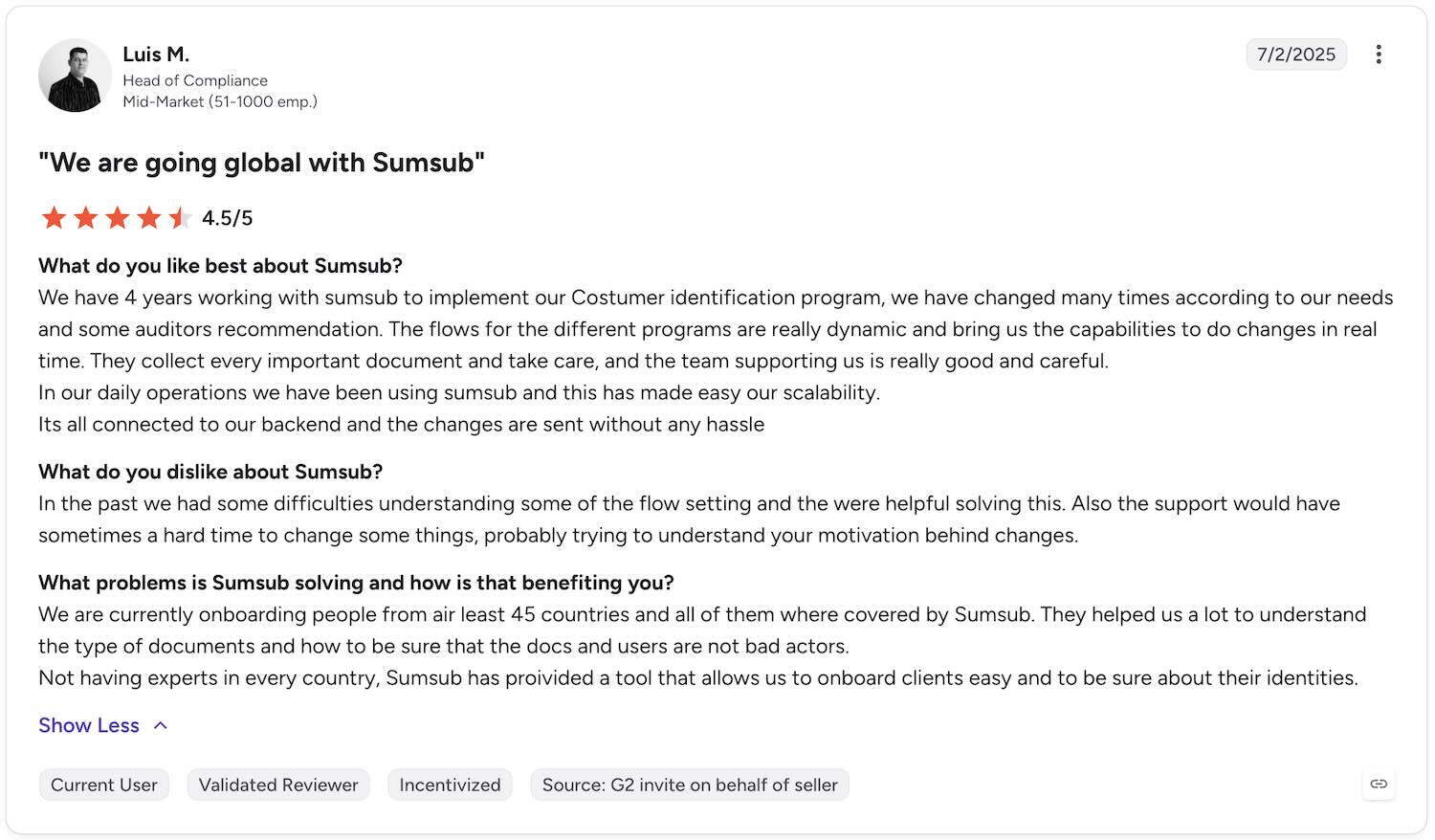
In general, customer reviews position Sumsub as a mature, feature-rich identity verification provider that particularly suits companies needing flexible, multi-market ID verification. Its strongest qualities are broad product coverage, workflow flexibility, integration options, and the ability to support high verification volumes. That said, businesses with simpler needs or smaller budgets should check whether the platform’s complexity and pricing fit what they need.
Source G2.com
Entrust (formerly Onfido)

Public reviews by customers: (5.0 Capterra | 4.4 G2 | 4.7 TrustRadius | 4.3 Gartner)
Onfido website: www.onfido.com
Onfido, now operating under the Entrust brand after its April 2024 acquisition, is one of the most established names in identity verification. It’s best known for Workflow Studio, a no-code tool for building verification flows that lets compliance and product teams adjust document types, liveness rules, and risk thresholds without writing code. As a result, for regulated businesses that need to respond quickly to changing rules across multiple markets, that flexibility is a genuine advantage.
Pros
- Onfido is recognized as a well-established, large “corporate-style” enterprise provider. They are backed by massive investment, which gives them a significant footprint in the identity verification market.
- Mature, enterprise-grade document and biometric verification with solid global coverage and a well-known AI engine (Atlas).
- Backing of a larger identity company (Entrust) means a wider product ecosystem to grow into.
- Strong Smart Capture experience across web and mobile
- Multiple facial capture methods, including photo, video, and motion
- Strong Known Faces functionality for duplicate-face detection
- Advanced no-code workflow orchestration
- Good trusted-database and electronic identity support
- Regional hosting environments in the EU, US, and Canada
- Strong European identity-proofing certification
- Broad enterprise security and identity ecosystem
Cons
- Some prospects evaluating the market noted that Onfido’s base pricing can be quite expensive, citing quotes of around $2.25 per verification, starting from $15.000 USD annual subscription.
- Charging for Denials: Onfido charges a fee for every completed verification attempt, regardless of the outcome. This means a business is billed even if the verification is denied due to a fake ID, expired document, or a fraudster failing multiple attempts.
- Slower response times: clients report severe delays with customer service, noting that it can take up to a week just to get a response to a technical support ticket.
- Email, phone, and behavioral fraud signals are less prominent than with some fraud-focused providers
- Complete white labeling may depend on the selected package and implementation method
Pricing Model
- Pay per each verification attempt – charged regardless of outcome (approved, denied, canceled, unfinished, or abandoned);
- Pricing is quote-based with no public tiers;
Best Suited For
- Banks and financial institutions
- Enterprise fintech companies
- Payment providers
- Trust-service providers
- Electronic-signature platforms
- Large international digital businesses
- Companies already using Entrust identity or security products
- Organizations requiring configurable identity-verification workflows
- European companies requiring certified remote identity proofing
Best Identity Verification Use Cases
- Digital account opening
- Photo, video, or motion-based liveness
- Known-face detection
- Repeat-document detection
- NFC passport verification
- Electronic identity verification
- Trusted database identity checks
- Risk-based step-up verification
- Returning-user biometric authentication
Overall assessment
In short, Entrust is a strong choice for large companies that need mature identity verification combined with enterprise workflow management. Its Smart Capture technology, Known Faces feature, and certified European identity-verification flows are key strengths.
However, it may be less attractive for smaller businesses looking for simple packaging, clear self-service pricing, or a lightweight standalone product.
What Customers Say
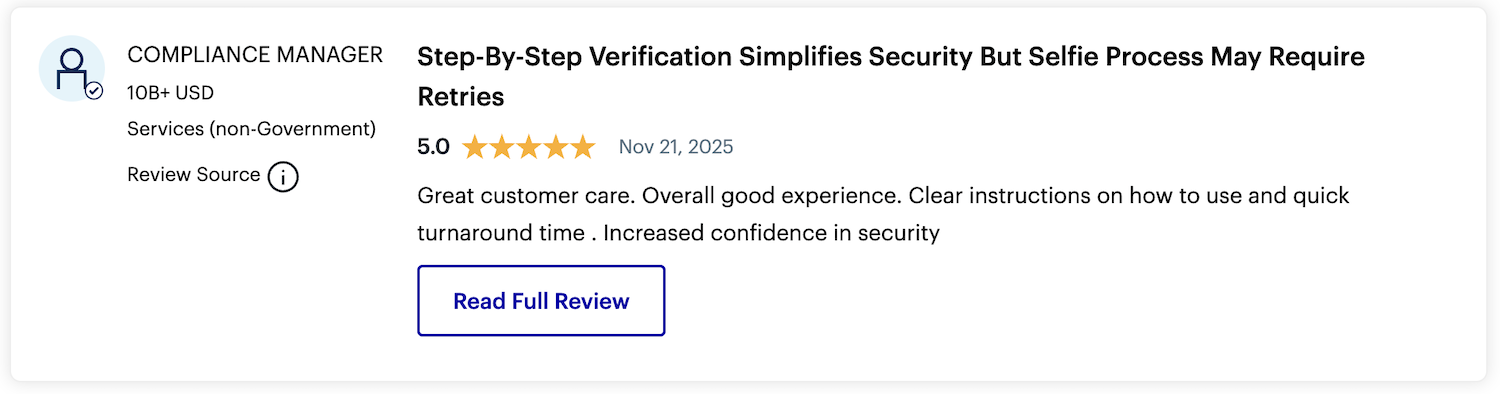
Overall, Onfido averages 4.6 across review platforms, with a perfect 5.0 on Capterra. The consistent positives are a clean, well-designed interface, strong SDK integration quality, and fast verification processing. For instance, compliance teams highlight the Workflow Studio as a practical tool for managing multi-market regulatory requirements without developer dependency – the ability to change verification parameters quickly is valued by teams that operate in heavily regulated industries where rules shift frequently.
By contrast, the recurring criticisms are: false rejections on valid documents appear more often than users expect, which generates real user support tickets and erodes trust in the automated layer. Some reviewers also flag pricing complexity – quote-based, pay-per-attempt billing makes cost forecasting difficult, and actual costs at scale can differ a lot from initial estimates. Support response times are generally rated positively by enterprise accounts; smaller customers report more variable experiences.
Source Gartner.com
Veriff

Public reviews by customers: (4.7 Capterra | 4.5 G2 | 4.0 TrustRadius | 4.4 Gartner)
Veriff website: www.veriff.com
Veriff is an identity verification and fraud-prevention provider. Its platform combines document checks, selfie and liveness checks, device and network intelligence, behavioral signals, face blocklisting, and cross-session fraud analysis. In particular, Veriff focuses on reducing verification friction while still catching advanced identity fraud.
Pros
- Strong financial backing. Veriff is recognized by competitors as a heavily venture-capital-backed company with a massive marketing budget, giving them a strong, well-established presence and high visibility in the identity verification market.
- Flexible “Pay-As-You-Go” Model Veriff is highlighted as an attractive option for startups or businesses with unpredictable verification volumes because they offer a flexible pay-as-you-go model with a very low barrier to entry.
- Clear pricing models publicly available on their website. This straightforward approach to displaying costs allows businesses to evaluate the service before engaging with a sales team.
- Good fit for regulated onboarding. The Plus and Premium plans are aimed at fraud prevention and regulated industries, with features like Risk Insights, FaceBlock, CrossLinks, video recording, and manual fallback.
- Device, network, and behavioral fraud signals
- CrossLinks functionality for connecting suspicious sessions
- FaceBlock functionality for customer-controlled biometric blocklists
- Strong duplicate-account and velocity-abuse detection
- Facial age estimation and age validation products
Cons
- Short storage times: on their pay-as-you-go or cheaper plans, Veriff only stores a customer’s verification data for three to six months before deleting it.
- Customers complain that Veriff charges a fee for every completed or “successful” submission, regardless of the actual outcome. This means businesses are charged even if the verification is denied due to an expired document, blurry photo, or a fraudster failing multiple attempts.
- To extend data retention to two years (which is often necessary for regulatory compliance), Veriff charges an extra fee of $0.30 to $0.40 per verification.
- No human support on basic plans: their self-serve and pay-as-you-go plans offer no human tech support or dedicated account managers, leaving clients to rely on AI chatbots.
- Customer control over the overall risk-scoring formula is less clear than with Persona or Sumsub
- Government-database coverage is broad, but direct AAMVA access is not always explicitly identified
- Complete workflow customization appears less extensive than Persona or Entrust
Pricing Model
- Pay per completed ID verification – charged for approved and denied sessions;
Best Suited For
- Fintech and payment companies
- Cryptocurrency platforms
- Online marketplaces
- Mobility and vehicle-rental businesses
- Recruitment and HR platforms
- Businesses facing repeated-account abuse
- UK employers using digital Right to Work checks
Best identity verification use cases
- Duplicate-face and linked-session detection
- Face blocklisting
- Multi-accounting prevention
- Device and network fraud detection
- Promotion and bonus-abuse prevention
- Age estimation and age validation
- Biometric authentication
- UK Right to Work verification
Overall assessment
Veriff is particularly strong for companies that prioritize global document checks, user conversion, and identity-focused fraud detection. CrossLinks, FaceBlock, and device and network intelligence help set it apart from basic document-verification providers.
Before buying, though, check its data-residency options, database sources, and how flexible its workflows are.
What Customers Say
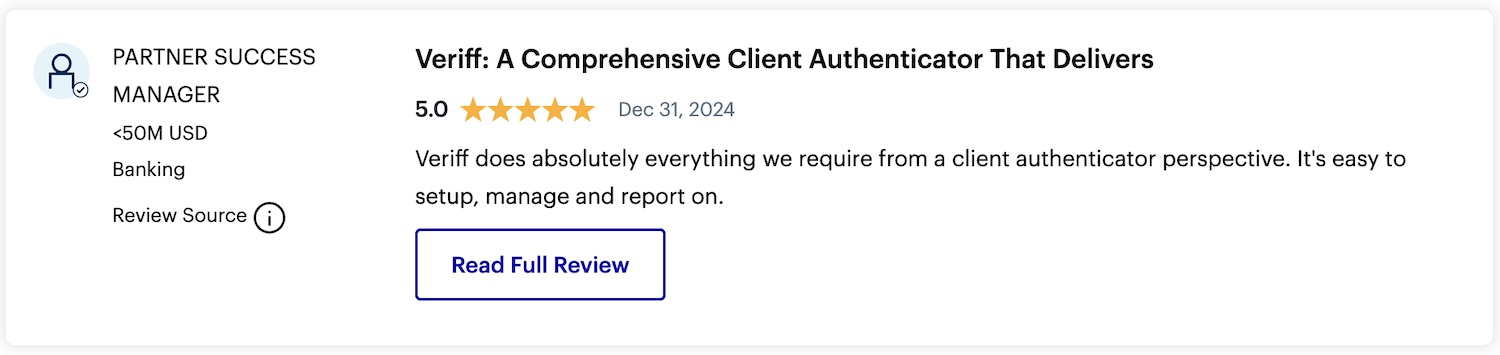
Veriff averages 4.48 across four platforms – solid but with a split between the higher Capterra and Gartner ratings (4.7 each) and a notably lower TrustRadius score (4.0). The consistent positives are document coverage breadth, international usability, ease of integration, and the quality of technical documentation. Similarly, product and engineering teams specifically mention that the API is well-structured and the integration process is straightforward. In financial services contexts, the KYC validation quality and reduction in manual review time are frequently cited as reasons for staying on the platform.
On the other hand, the consistent negatives are pricing (described as difficult to justify at scale compared to alternatives) and support accessibility outside enterprise tier, some users report difficulty getting timely responses from the support team. UI/UX improvements are a recurring ask, with some reviewers noting the interface could be more intuitive for non-technical compliance staff who need to work in the dashboard regularly.
Source Gartner.com
Persona
Public reviews by customers: (4.9 Capterra | 4.3 G2 | 4.5 Gartner)
Persona website: www.withpersona.com
Persona is a flexible identity verification platform that lets businesses build custom onboarding and identity-checking journeys. It combines document checks, selfie checks, passive fraud signals, trusted database checks, blocklists, graph analysis, and dynamic workflow management.
Rather than offering one standard verification flow, Persona lets customers build different processes for different users, risk levels, regions, and products.
Pros
- Highly flexible no-code verification-flow builder
- Strong hosted, embedded, native SDK, and API integration options
- Extensive passive device, behavioral, network, and visual fraud signals
- Strong face, device, IP, email, phone, and identity Lists
- Graph functionality for linked-account and fraud-ring analysis
- Direct AAMVA driving licence verification
- Direct US Social Security and telecom-carrier database checks
- Strong US public-sector identity assurance
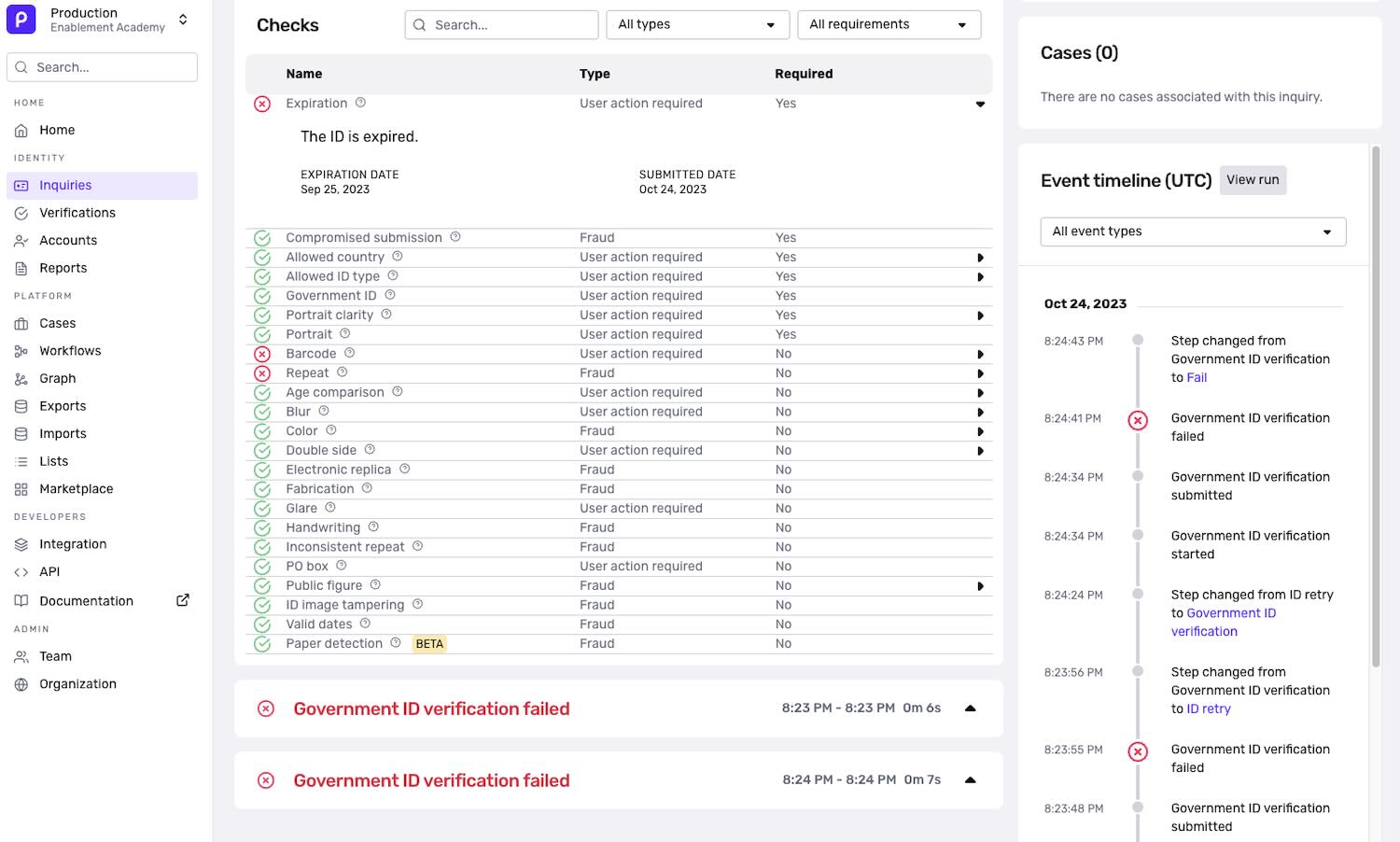
- Strong real-time capture guidance
Cons
- Heavily US-oriented, with limited international coverage – not the natural choice if you’re onboarding globally.
- Geared toward government/enterprise rollouts rather than flexible, developer-led commercial onboarding.
- Pricing can be highly inaccessible for startups and smaller businesses.
Pricing Model
- Pay per completed ID verification – charged for approved and denied sessions;
What Customers Say
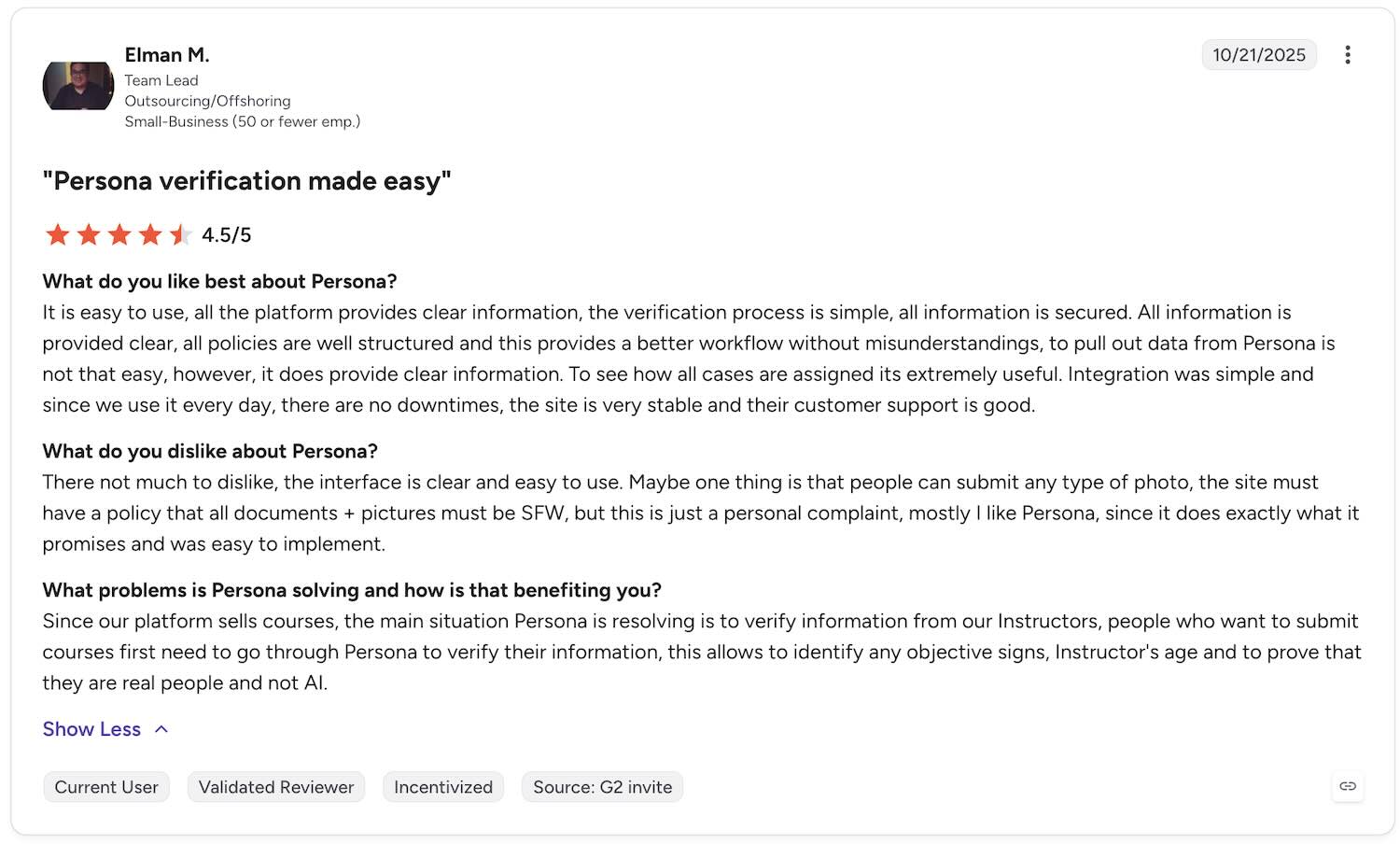
In general, customer reviews position Persona as a flexible, developer-friendly identity platform that especially suits businesses needing custom identity workflows and multiple verification methods. Its main strengths are customisation, integration options, usability, and workflow management. That said, companies with simple verification needs or limited budgets should weigh whether they need the platform’s broader features and added complexity.
Source G2.com
DISCLAIMER
Data sourced from public information and vendor websites as of 2026. This is not a final verdict or endorsement – details can change. Reach out to vendors directly for current pricing and feature availability. To flag anything missing or incorrect, contact the website owner.