Over the years, Anti-Money Laundering (AML) initiatives have aimed to increase the difficulty of concealing illicit profits. Despite AML regulations mandating that financial institutions create advanced customer due diligence strategies for evaluating money laundering risks and spotting suspicious transactions, non-compliance cases continue to rise annually.
Initially, AML regulations primarily targeted banks and similar entities. However, they have expanded their reach to encompass a wide range of institutions. This includes not only traditional banks but also iGaming platforms or cryptocurrency exchanges.
While various AML guidelines and regulations exist worldwide, AML programs typically consist of five fundamental pillars that you need to know, especially if you’re operating in a high-risk sector.
What is Anti-Money Laundering (AML) Compliance?
Anti-money laundering (AML) compliance is a set of measures and procedures that regulated companies, such as fintech platforms, are required to implement as a defense mechanism and to prevent fraud, money laundering, or terrorism financing. Regulated platforms aren’t just banking or fintech. Almost any monetized firm that facilitates transactions needs to comply with AML rules. Some of the most well-known AML compliance processes include screening the customer against various sanctions lists or monitoring their transactions to detect anomalies, such as transitions from high-risk countries that are typically known for their high corruption or fraud rates and differ from the user’s registered address details.
The Bank Secrecy Act (BSA) mandates that financial institutions must create AML programs to effectively combat illicit activities. In the UK, the Money Laundering Regulations (MLRS) and in the US, the Anti-Money Laundering Act of 2020 help companies establish comprehensive AML programs with standard guidelines, assisting them in safeguarding both themselves and their customers from crime.
Related: AML Compliance Program — Step-By-Step Guide in 2023
Automate your AML checks
Screen customers against global sanctions, PEPs, and watchlists in real time with iDenfy AML Screening.
AML Screening SoftwareWhat are the Pillars of an AML Compliance Program?
While the BSA specifically applies to the United States, the five AML pillars are recognized internationally. That means businesses globally employ them when developing their own AML compliance programs.
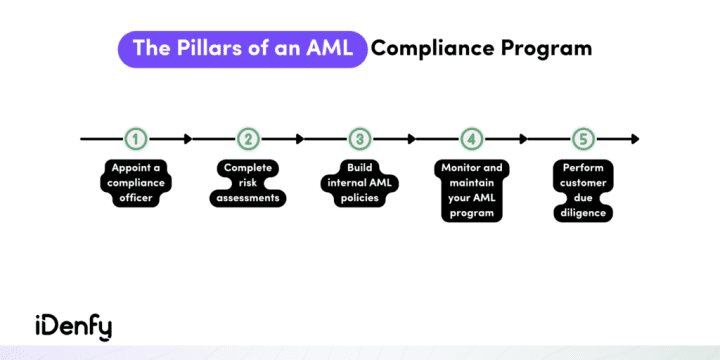
The five pillars of AML compliance offer a holistic approach, emphasizing internal controls, assigned roles, training and awareness, independent testing, and a risk-based strategy for ongoing Customer Due Diligence (CDD).
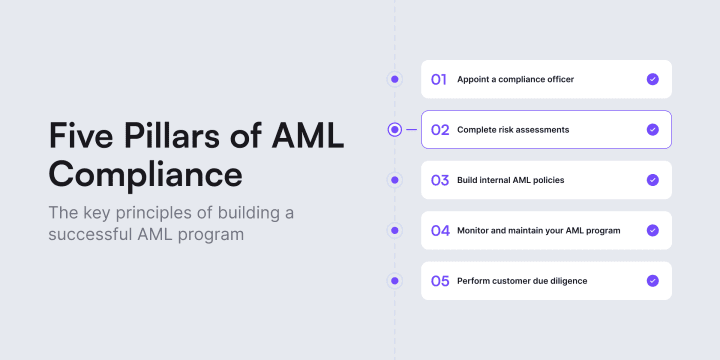
The five pillars of AML consist of:
- Designating a compliance officer
- Completing risk assessments
- Building internal controls and AML policies
- Monitoring and auditing your AML program
- Performing CDD
Below, we’ll review the five pillars of AML compliance in more detail.
1. Designate a Compliance Officer
The first step is to find a person in your company who would be responsible for the whole AML program. A designated compliance officer’s duties consist of ensuring compliance and, at the same time, sharing and updating their AML expertise with the whole company. They typically assess existing processes, create new processes, and ensure that the revised strategy aligns with all current AML regulations and is effectively implemented in your company.
Other compliance officer duties include:
- Recommending modifications based on audit findings
- Training and updating staff members on compliance regulations and changes
- Communicating these changes to stakeholders and management
It’s important that the designated compliance officer has a deep understanding of the industry your company operates. They also serve as the main point of contact for regulatory authorities.

2. Complete Risk Assessments
To have a robust AML compliance program, you must establish clear protocols, controls, and procedures for detecting financial crimes. Your compliance measures should also follow a risk-based approach. That’s why you must tailor your mitigation measures based on the level of risk. That’s because each organization operates differently, and policies must incorporate customized strategies.
A neobank offering instant cross-border transfers to underbanked populations carries different exposure than a domestic mortgage lender. A payments platform processing high volumes of small transactions faces structuring risk that a private wealth manager simply doesn’t. The identification phase forces you to be specific about your own model, not just reference industry-generic risk typologies.
In practical terms, these AML compliance controls should include various measures. For example, customer identity verification, screening and monitoring, as well as the ability to report suspicious activities to the relevant authorities. Keep in mind that risk assessments are not static. They should be periodically reviewed and updated to account for changes in the institution’s operations, regulatory environment, and evolving risks.
Companies often manage their risks by implementing these processes:
- Assessment. Identifying risks is only half the work. The harder part is evaluating them and scoring each risk by likelihood and potential impact, then using that output to make real decisions about where to invest compliance resources.
- Customer risk profiling. Your risk assessment should translate directly into how you categorize and treat individual customers. Not every customer carries the same exposure, and your due diligence intensity should reflect that. The same applies to customers in FATF grey-listed jurisdictions, those running cash-heavy businesses like money services bureaus or luxury goods dealers, and any customer whose stated business doesn’t align with their transaction behavior.
- Transaction monitoring. Rule-based transaction monitoring is necessary but not sufficient on its own. Generic scenarios, like flagging anything over €10,000, alert on round-number transfers generate enormous volumes of false positives and miss the patterns that actually matter for your specific risk profile. Flagged transactions should feed into SARs that are filed accurately, and with enough detail to be audit-compliant.
3. Build Internal Controls and AML Policies
To effectively manage risks, it’s crucial to establish a well-defined compliance department. That means staying informed about emerging market trends and new compliance regulations. For instance, many financial firms now embrace environmental, social, and governance (ESG) policies to align with customer expectations.
Of course, training is where most AML programs are weakest. Annual e-learning modules do not produce a compliance-aware workforce. Relationship managers need to recognize behavioral red flags in real client interactions. A customer who deflects source of funds (SOF) verification questions, one who insists on using unusual payment routes, or one whose business description shifts between conversations. Fraud analysts need hands-on familiarity with the detection tooling in use, not just conceptual awareness of what it does. When every employee understands how financial crime risk intersects with their specific role, the program functions as designed.
Numerous external organizations offer training programs, so you don’t need to handle all training in-house. Importantly, training should not be a one-time event. Your designated AML compliance officer should ensure regular refresher training whenever updates or changes are made to your AML compliance program.
Related: What is an AML Risk Assessment? [With Examples]
4. Monitor and Audit Your AML Program
Not only internal training and monitoring of AML programs are crucial, but also conducting regular auditing of your compliance program by independent third-party entities. That’s because a proper evaluation of an institution’s compliance cannot rely solely on internal testing. These regular third-party audits help identify potential vulnerabilities in your compliance program. Keep in mind that they are essential to uphold operational integrity.
It’s important to note that these compliance audits are distinct from financial audits. They solely concentrate on AML regulations and the company’s efforts to safeguard against criminal activities. Annual audits are a bare minimum, but institutions facing elevated money laundering risks should keep up with a more frequent auditing schedule. That’s how your independent auditing will help identify outdated practices and streamline AML processes. It plays a critical role in identifying weaknesses, improving practices, and demonstrating compliance with regulatory authorities.
Related: What are the Key AML Laws in the US? [Business Guide]
5. Perform Customer Due Diligence (CDD)
In May 2018, the Financial Crimes Enforcement Network (FinCEN) implemented the Customer Due Diligence (CDD) rule. Today, it’s become one of the five fundamental pillars of AML compliance. The CDD rule obliges companies to identify and verify the identity of their customers and continuously monitor their activities to detect and report any suspicious transactions.
Under the reporting pillar, compliance teams also have to file the right reports: a Currency Transaction Report (CTR) for large cash transactions above the regulatory threshold, and a Suspicious Transaction Report (STR) whenever activity shows possible signs of money laundering.
A money mule is a person who moves illegally obtained funds on behalf of someone else, often unknowingly, which is why monitoring and reporting suspicious transactions is so important for stopping money laundering.
In general, performing CDD consists of four core elements:
- Verifying the identity and assessing the risk level of each customer.
- Identifying the beneficial owners of legal entities.
- Understanding the nature of customer relationships.
- Continuously monitoring transactions to detect any suspicious behaviors or patterns.
The CDD rule recommends a risk-based approach, where organizations assess both customers and transaction requests based on their level of risk. Assessing the risk associated with each customer and transaction allows you to customize your due diligence efforts. You should apply enhanced due diligence (EDD) measures when dealing with higher-risk situations. For example, if a customer is from a high-risk area where the risk of money laundering is high, you should apply due diligence measures.
Related: Customer Due Diligence Solutions — How to Build CDD Compliance?
How to Stay AML-Compliant?
If implementing the five pillars of AML, monitoring transactions, submitting reports, conducting regular audits, or training new employees all at once seems too much of a hassle, you should consider implementing AML Screening and other AML solutions, such as risk assessment and risk-scoring tools that can help identify high-risk clients who need extra attention from compliance analysts. With that in mind, AI-powered RegTech software can help you streamline your AML operations while ensuring a frictionless experience for the end customer. For compliance analysts, the daily reality is alert overload, fragmented workflows, and manual processes that consume hours better spent on genuine risk investigation. SAR filing backlogs, inconsistent customer risk scores, or data gaps between onboarding and monitoring when profiles change are persistent problems that no single, unified AML policy solves.
That means your job is to help your in-house team solve AML-related issues and save time spent on manual tasks, like EDD. Automated AML workflows, AI agents and summaries on where to start after receiving an edge case isn’t a utopia anymore. RegTech solutions like iDenfy offer it in their AML service stack. Additionally, it’s essential to regularly update your AML program as new laws are enacted and regulations evolve. Neglecting this could potentially lead you to enormous fines and losses for your business — and we don’t want that.