
Anti-Money Laundering (AML) compliance requires regulated entities to implement various checks that are designed to prevent financial crime and fraud, including serious offences like money laundering or terrorism financing, which go undetected via techniques like offshore accounts and other ilicit methods, especially linked to corporate entities that hide the true ownership or money mules that are paid for their role in the money laundering scheme.
A huge part of AML compliance for high-risk entities like banks and others that are vulnerable to fraud is implementing the risk-based approach (RBA), which means assessing risks based on different factors that are relevant to the company. Among popular blueprint risk factors are the location and the country of the client. For example, customers from sanctioned jurisdictions are always flagged and automatically blocked. In practice, this is achieved using an AML software that has built-in PEPs and sanctions checks.
PEPs, or Politically Exposed Persons, on the other hand, are always considered high-risk clients; however, they aren’t automatically prohibited from doing business with them, as it depends on the company’s internal risk appetite. That’s why PEP screening helps identify people who often pose a higher risk of corruption or bribery, including other threats, such as money laundering. Consequently, both PEPs and sanctions checks are a key part of customer due diligence (CDD) and are required by AML regulations.
Why is the Process of PEPs and Sanctions Screening Important?
PEPs and sanction screening, along with other AML processes, such as screening individuals against global watchlists and adverse media, help flag high-risk individuals or entities:
- Customers who fall under the PEP status are considered to be more prone to illicit activities due to their connections and prominent status, which makes them vulnerable to corruption.
- Individuals and entities are sanctioned for serious offenses, including terrorism financing, human rights violations, or actions that endanger global peace and security.
All businesses that deal with financial transactions should assess their partners, third-party suppliers, affiliated companies, and linked individuals to determine whether there are any sanctioned bodies. In many jurisdictions, working with such entities is considered illegal and a non-compliance risk.
PEPs and sanction screening, along with other AML processes, such as screening individuals against global watchlists and adverse media, help flag high-risk individuals or entities:
- Customers who fall under the PEP status are considered to be more prone to illicit activities due to their connections and prominent status, which makes them vulnerable to corruption.
- Individuals and entities are sanctioned for serious offenses, including terrorism financing, human rights violations, or actions that endanger global peace and security.
All businesses that deal with financial transactions should assess their partners, third-party suppliers, affiliated companies, and linked individuals to determine whether there are any sanctioned bodies. In many jurisdictions, working with such entities is considered illegal and a non-compliance risk.
Automate your AML checks
Screen customers against global sanctions, PEPs, and watchlists in real time with iDenfy AML Screening.
Explore AML ScreeningHow to Choose AML Software for a Better PEPs and Sanctions Screening Process
Like any RegTech service, you should pay attention to key factors like your industry specifics, geographic reach, automation capabilities, and the coverage of the tool’s database. In this case, support for multiple PEP and sanctions lists is necessary. The AML software should offer both screening and ongoing monitoring capabilities to track any status changes across PEPs and sanctions databases, preferably also check clients against watchlists and adverse media, while automatically determining customer risk to maintain accurate risk profiles throughout the whole business relationship.
To stay reliable, screening software must be regularly updated with the latest sanctions and PEP list changes. Speed and efficiency also matter. All in all, automated AML solutions should quickly process large data sets and help businesses detect potential matches in real time.
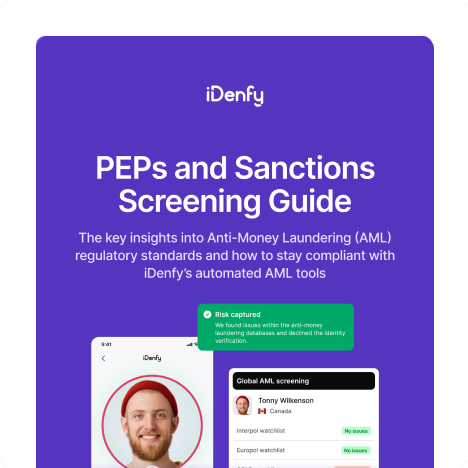
But what else is there to know, and how can you make your PEPs and sanctions screening more effective? We provide practical tips and steps to build a custom, fully automated AML compliance system in our guide.
What’s inside:
- A breakdown of PEP and sanctions screening in AML compliance
- The biggest AML screening challenges and how to solve them
- How iDenfy automates PEPs and sanctions checks across global databases
- Key features that make iDenfy’s AML software accurate, fast, and audit-ready
 Download PDF
 Try for free


