The EU adopted the regulatory framework of the Markets in Crypto-Assets Regulation (MiCA), which provided a clear and complete legal framework for crypto-assets and related services. The MiCA regulation aims to establish a regime across EU member states to establish a unified digital finance market environment.
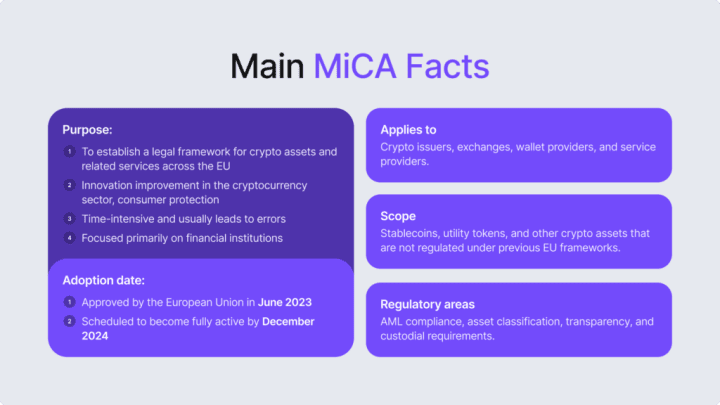
Adopted in June 2023, MiCA seeks to provide clarity for crypto-asset issuers and service providers by offering various definitions and rules. It also includes various digital assets: asset-referenced tokens, e-money tokens, and other crypto assets not covered by previous financial regulations. As a catch-all, this regulation protects users and provides transparency regarding legal certainty, market integrity, and innovation in the ever-growing crypto market.
What is the Markets in Crypto-Assets Regulation (MiCA)?
The fundamental principles of MiCA include mitigating risks for investors, ensuring financial stability, and promoting innovation, achieved by considering such important areas:
- Consumer and investor protection: MiCA wants to protect consumers against financial loss, fraud, and other risks concerning the usage of crypto assets; clear disclosure and enough information about the nature of crypto assets are laid down by the MiCA to give consumers the necessary knowledge to make good choices.
- Legal certainty: MiCA explains, once and for all, the exact definition of various types of crypto-assets and brings certainty to rules concerning their issuance and trading, thus providing legal certainty to the participants in the industry. This lack of ambiguity existed only in different jurisdictions.
- Counteracting market abuse: MiCA provides provisions against market manipulation, insider trading, and other similar practices that may affect the crypto market. The users in this market will be obliged to behave correctly and be punished for unethical behavior.
- Support for innovation: MiCA seeks to drive innovation by providing one single regulatory framework within which crypto businesses will be free to operate rather than facing conflicting rules from different jurisdictions. This regulatory clarity incentivizes FinTech companies and projects using blockchain to start up and scale in the European market.
Automate your KYC process
iDenfy verifies customers from 200+ countries in seconds. AI-powered, compliant, and trusted by 1,000+ companies.
Explore KYC SolutionWho is Considered a Crypto-Asset Service Provider?
A CASP can be any business providing the following services in the EU:
- Operating a crypto exchange or offering exchange services
- Offering custody and administration of crypto assets on behalf of a third party
- Providing crypto advisory services or investment advice related to crypto assets (except for portfolio management)
Crypto asset service providers, or CASPs, were first mentioned in 2020, when there was a draft for the MiCA regulation, which has now been finalized (since June 2023). The term in MiCA helped establish a unified legal framework for managing virtual assets and regulating the crypto market while enforcing new anti-money laundering (AML) and counter-terrorist financing (CTF) rules.
The Difference Between a Virtual Asset Service Provider and a CASP
The main difference between CASPs and VASPs lies in their regional use and regulatory origin:
- CASP, or Crypto Asset Service Provider, is a term used within the EU under the MiCA regulation.
- VASP, or Virtual Asset Service Provider, is used outside the EU, for example, in the US, and is defined by the Financial Action Task Force (FATF).
Related: Cryptocurrency Regulations Around the World
The Role of KYC in MiCA
An essential factor of MiCA’s framework is the focus on proper KYC implementation. Know Your Customer (KYC) is a process that verifies clients to prevent various crimes like money laundering, fraud, and other similar crimes.
Under MiCA, crypto-asset issuers and traders must be subject to implementing a KYC process. It applies to:
- Crypto-asset service providers (CASPs)
- Wallet providers
- Crypto-trading platforms
- Cryptocurrency exchanges
- Crypto-asset advising companies and crypto-portfolio managers
The KYC requirements would set up transparency and accountability and prevent illicit activities in the digital finance ecosystem. These measures involve service providers obtaining and confirming information from their clients, such as IDs and information about their business activities. MiCA seeks to create an open yet secure crypto-asset ecosystem in which trust is strengthened among participants. At the same time, criminal activities are discouraged, which has defined the narrative around cryptocurrencies in recent years.
Implementing KYC is both an opportunity and a challenge for crypto businesses; an improved KYC mechanism means better security and lower risks for providers and users, but at higher compliance costs and increased operational effort. Nevertheless, the main objective of MiCA is to create an industry that is safe and trustworthy, one that will fundamentally change the future of finance.
Related: Crypto Theft Statistics & Trend Predictions: The Role of KYC/AML
MiCA and Whitepaper
MiCA introduces how crypto-assets are administered in the European Union. MiCA states that issuers should provide a whitepaper with all crypto assets when released or begin trading for the first time.
The whitepaper should contain information such as:
- The project itself
- Details about the project’s purpose
- The technology behind the assets
- The rights associated with issuers
- Any risks that could occur and be potential
Issuers should take these measures to provide transparent and clear information to investors before making any transactions.
Moreover, the MiCA requires that issuers submit the whitepaper to the national authorities. Rather than a simple registration procedure, this step will give full responsibility to the issuers for the data shown and thus help develop trust in the market. MiCA tries to bring crypto-assets closer to conventional standards for disclosure and transparency, creating a safer and more reliable environment for investors and the whole market.
KYC and AML Compliance
KYC and Anti-Money Laundering (AML) are essential for keeping the financial world honest and reliable. KYC, or identity verification, is part of the bigger AML framework. In simple terms, AML compliance focuses on identifying and minimizing the risks of money laundering, a big concern often tied to crypto-assets because of their decentralized structure and anonymity.
To comply with both KYC and AML requirements, CASPs should implement these processes:
-> Know Your Customer: CASPs must conduct adequate KYC, including verification of customers’ identities with government-issued identification and proof of residence address. Without these processes in place, virtual currency services are susceptible to possible money laundering or terrorist financing by illicit actors.
-> Enhanced Due Diligence: CASPs should apply EDD for transactions above €10,000 or when the countries of origin are considered high-risk, implementing an in-depth analysis of the fund’s source and the transaction’s origins, adding layers to mitigate risk.
-> Ongoing monitoring: CASPs must ensure that the process of monitoring customers’ transactions is there for suspicious activities, implementing real-time monitoring systems of transactions and regular auditing to meet the standards set in AML.
-> Record-Keeping and Transparency: All CASP records, as well as information about customer records, should be maintained for a period of at least five years. In addition, the policy on AML and the practice of pricing have to be declared in public with regard to every relationship involving customers.
MiCA and the FATF Travel Rule
MiCA doesn’t operate in a vacuum. It sits alongside a global push from the Financial Action Task Force to close the anonymity gap in crypto transfers, and the mechanism for that is something called the Travel Rule. In plain terms, it requires crypto-asset service providers to attach sender and recipient information to transactions above a certain threshold, just as banks have had to do with wire transfers for years.
The EU version of this shows up in its own transfer-of-funds regulation, running in parallel with MiCA, and it’s part of why the KYC obligations under MiCA feel stricter than what a lot of crypto businesses were doing before. It’s not just “verify your customer once at signup” anymore. It’s making sure that identifying information actually travels with the money, transaction by transaction, so a transfer can be traced back to a real person on both ends. For CASPs operating across borders, this is often the part of compliance that catches people off guard, since it requires coordination with whichever provider is on the other side of a transfer, not just internal recordkeeping.

Related: A Definitive Guide on KYC for Crypto [Updated]
KYC Implementation and Its Challenges
Introducing KYC rules to the crypto world is a challenging task. Blockchain’s pseudonymous nature means users value their privacy, which doesn’t always align with the transparency KYC demands; it puts service providers in a tough spot, so to be safe, they must stay compliant without driving away their customers. Complying with these rules takes a hefty investment in tech, like identity verification tools and transaction monitoring systems; smaller crypto companies may feel devastated by such significant investments.
Despite the challenges, the benefits of KYC implementation easily outweigh the downsides; it’s not just about making the market safer and more transparent; these efforts also help build public trust. And let’s face it, trust is key to boosting mainstream acceptance and the growth of crypto-assets and blockchain technology; we could say that in the big picture, it’s a win-win for everyone.
Challenges for Service Providers
MiCA’s introduction brings significant challenges for crypto-asset service providers:
- Compliance Costs: MiCA requires huge infrastructure investments for compliance, human resources, and advanced software solutions. Compliance costs may overburden smaller service providers needing more investment capacity to develop sophisticated AML and KYC mechanisms.
- Balancing Privacy and Regulation: The crypto community values privacy a lot, but MiCA requirements conflict with this standard, as they demand personal identification and details of transactions. The biggest challenge is to find a balance between meeting the regulator’s demands and upholding user privacy.
So, it’s fair to admit that KYC and MiCA compliance are challenging. After all, offering the highest level of KYC and meeting AML standards requires billions in investments, and finding a balance among all compliances and privacy concerns takes time to crack. Yet, advantages like increased transparency, market stability, and consumer trust make MiCA a unique opportunity for the crypto industry to mature and gain wider acceptance.
Related: KYC Verification [3 Main Components & More]
How MiCA Compares to Crypto Regulation Elsewhere
The EU isn’t the only one figuring this out, and it’s useful to see how MiCA compares with others’ approaches. The US doesn’t have a unified crypto framework – the SEC, CFTC, and FinCEN all claim jurisdiction depending on how a given asset is classified, which has led to drawn-out legal fights over what actually counts as a security. Individual states have gone their own way, too: Wyoming has built crypto-friendly laws from scratch, while New York’s BitLicense is one of the strictest regimes anywhere.
The UK has taken a middle path, layering AML and KYC requirements onto crypto businesses through the FCA while still positioning itself as a place crypto companies want to set up shop. Asia is genuinely split down the middle – Singapore has clear, supportive rules for digital payment tokens, and Japan tightened everything after the Mt. Gox collapse, while China banned crypto trading outright in 2021.
Against that backdrop, MiCA looks less like just another regional rulebook and more like the first real attempt to give an entire bloc a single, consistent standard. It’s stricter than some jurisdictions and looser than others, but the fact that it’s a single set of rules covering 27 countries is genuinely rare in this industry, and it’s part of why MiCA compliance tends to get treated as something of a benchmark for CASPs operating anywhere.
Which Crypto Exchanges Don’t Have a MiCA License?
MICA’s transition period closed on July 1, 2026, and the results weren’t kind to most of the industry. Out of roughly 3,000 crypto firms operating in the EU, only a couple of hundred made it through in time. Everyone else is technically operating illegally now if they’re still serving EU customers.
The name that made the most headlines is Binance. The exchange had been working through an application in Greece for months and, by its own account, was told the paperwork was complete back in April. Then approvals kept getting pushed back, and rather than wait it out, Binance pulled the application in late June, just days before the deadline. It’s now telling EU users it’s suspending new sign-ups, deposits, and trading while it applies through France instead. Withdrawals are still working, and the company says it’s not giving up on Europe, but it doesn’t have a license right now.
Bitget is in a similar spot. Its EU entity has applied through Austria’s regulator but hadn’t received approval as of the deadline, and the company’s own CEO has said the timeline is entirely in the regulator’s hands.
It’s worth being precise here, since much of the coverage blurs the lines: Bybit is not in the same category. It secured its CASP license from Austria’s FMA back in May 2025 and has been running a separate, fully licensed EU platform since mid-2025. Coinbase, Kraken, OKX, Crypto.com, and KuCoin are also licensed. So the practical divide right now isn’t “big exchange vs. small exchange” – it’s whether a given platform got its house in order early enough. Binance getting caught out despite being the largest player in the market is really the story here, and it’s a pretty clear signal that scale doesn’t buy you a pass on the fit-and-proper checks regulators are running.
How to Prepare for MiCA Compliance?
With MiCA taking effect in December 2024, crypto-asset service providers must prepare for new regulations. This means revising the old practices of compliance, mapping out the gaps that must be filled, and making such changes to match the requirements, all of which must be done under MiCA regulations. Thus, service providers are expected to emphasize enhancing KYC/AML compliance processes, bringing the systems to the minimum required levels by the regulation.
If you’re obligated to comply with the MiCA regulation, don’t forget the following steps:
1. Implement Automated Solutions for KYC/AML Compliance
One of the key focus areas for compliance requirements by MiCA is deploying the appropriate technological solution. Identity verification platforms and automated transaction monitoring systems will be able to facilitate service providers in the detection of suspicious activities to prevent money laundering in compliance with regulatory requirements.
2. Conduct Internal Staff Training
Another important aspect of preparation involves investment in staff training and education. Service providers need people to have the necessary knowledge about the requirements set by MiCA. Training employees on handling the KYC process, identifying unusual behavior, and following AML procedures is at the heart of a compliance culture.
3. Collaboration with Regulators
Establishing communication with regulators could be very beneficial because regulatory authorities can provide valuable insights and information on compliance requirements, and collaboration between regulators can contribute to developing a more balanced regulatory framework that accommodates the interests of all stakeholders.
Conclusion
The introduction of MiCA signals the next phase for the crypto-asset industry in the European Union, creating one single regulatory regime – the goals of MiCA are to increase market integrity, enhance consumer protection, and promote innovation. The main focus within the KYC and AML in MiCA expresses the commitment of the EU, ensuring that the crypto industry is subject to a high level of security and accountability.
For crypto-asset service providers, alignment with MiCA requirements is not only about satisfying one binding jurisdiction but also a strategic step toward trust and long-term success within the constantly changing environment of digital finance. So, if you’re interested in learning more about iDenfy’s KYC products, book a free demo with us today. We offer state-of-the-art identity verification solutions designed to meet businesses’ needs in an evolving digital landscape.