Quick Intro
Ping Proxies is a UK-based ethical proxy provider and web-data collection platform. It helps businesses collect and analyse web data at scale by providing access to a global pool of over 35 million residential IPs and high-performance static ISP proxies. Since 2020, the company has been an industry leader, sourcing its proxies from premium carriers, including Spectrum, AT&T, Comcast, and Orange.
The Ping Proxies team follows a developer-first approach that differentiates the platform in a competitive market. By offering features such as real-time analytics, automated routing via Smartpath®, and AI-driven traffic optimisation, Ping Proxies delivers a highly adaptable solution. As a result, the platform supports a wide range of use cases, including data extraction, account management, web scraping, social media operations, and SERP analysis.
With over 25,000 customers served, Ping Proxies always prioritized delivering a seamless user experience, starting with the initial user onboarding process. However, as the customer base grew, maintaining accuracy and operational efficiency in identity verification became increasingly challenging. Manual KYC processes proved time-consuming and difficult to scale, making the Ping Proxies team look for a better alternative that fits its business model, which was an automated identity verification service.
The Challenges
As an established proxy brand, Ping Proxies aims to maintain trust through a strict compliance and security system, which complements the platform’s goal of providing the highest-quality proxy services. To reduce the risk of abusing its proxy services, Ping Proxies built a strict KYC policy right from the start. That meant the platform required all new users to complete identity verification by submitting a government-issued ID.
As the platform scaled, manually reviewing hundreds of identity documents became a complex and inefficient process, mainly because:
- The risk of having a backlog increased, and Ping Proxies wanted to change up its strategy and introduce automation to ensure sustainable service flow.
- Certain ID types were difficult to assess in-house, making it challenging to maintain the desired accuracy rate.
As a result, Ping Proxies needed to invest in hiring extra, skilled KYC specialists, which would have driven the costs up, or allocate development resources to build an automated onboarding solution entirely from scratch.
“Previously, our manual KYC processes were resource-intensive and increasingly unsustainable, as our customer base expanded. Additionally, verifying international ID documents accurately was beyond our in-house capability,” said Timur Gok, the Founder of Ping Proxies.
However, implementing a third-party ID verification solution didn’t automatically mean that such a switch would result in a perfectly seamless KYC process. Factors like accuracy and efficiency, as well as good fraud prevention capabilities, equally mattered to Ping Proxy. This was especially important as fraudulent sign-ups became a challenge that needed to be addressed without disrupting legitimate users who expected fast access to proxy services.
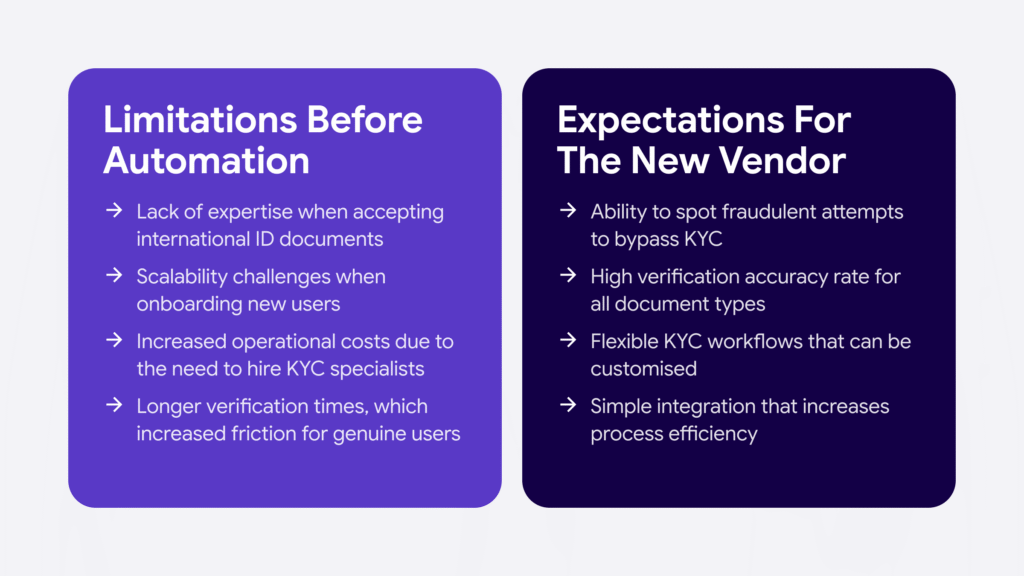
As a result, the ability to customize the KYC flow while minimizing friction and ensuring that issues like bonus abuse would be solved became a critical requirement:
“Our main challenge was scaling identity verification in a way that was both secure and operationally efficient. We needed to verify customers quickly and reliably to maintain the integrity of our proxy network, especially given the growing risk of fraudulent sign-ups and abuse of free trials,” explained Timur Gok.
The Solution
Before implementing iDenfy, the Ping Proxies team highlighted a few areas that they wanted improve, including:
- Internal resources, which were tied up in repetitive, low-value tasks, instead of being allocated to Ping Proxies’ Product Development or Customer Support teams.
- The bottlenecks from manual KYC checks, which slowed down customer onboarding, meaning potential customers dropped off during the sign-up process.
As Ping Proxies expanded, the platform’s manual identity verification checks proved to be an unrealistic approach to maintaining effective KYC compliance, at least without any sort of software or automation. The goal was to switch to a completely AI-powered, easily manageable KYC system using a third-party KYC service.
This tactic proved to be more suitable for Ping Proxies because it guaranteed measurable improvements in three key areas: efficiency, accuracy and fraud prevention.
“More critically, the lack of a scalable verification system directly risked the integrity of our proxy network, which we take extremely seriously,” said Timur Gok, the Founder of Ping Proxies.
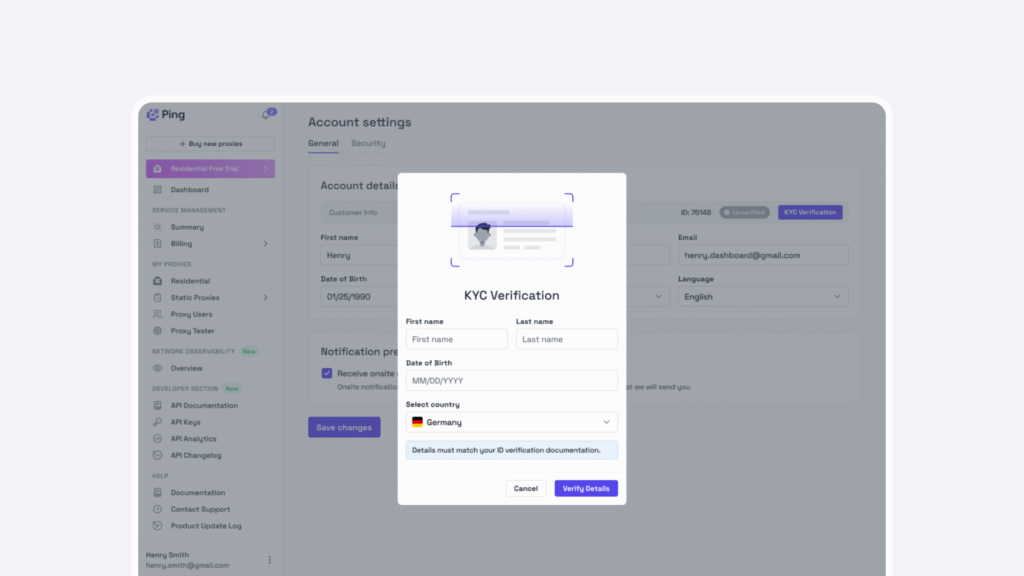
As a result, Ping Proxies implemented iDenfy’s identity verification service. The end-user workflow is now simple and familiar, consisting of two KYC-compliant elements:
- Personal data input. The user enters their full name, date of birth, and selects their country.
- Document verification. The user captures a government-issued ID, such as a passport or driver’s license.
Ping Proxies customized the identity verification workflows to match their risk appetite and the platform’s internal profiling system. This allowed the system to automatically trigger KYC verification only for accounts that met certain risk thresholds. As a result, low-risk users could onboard seamlessly, without being subjected to unnecessary verification steps.
“This ensured that the solution aligned with our business model and customer journey, rather than being a one-size-fits-all integration,” said Timur Gok.
Implementation
The implementation process was smooth. Ping Proxies integrated iDenfy through its well-documented API, completing the setup in just one to two weeks of development. This quick integration allowed the team to use the automated KYC system quickly and without it affecting other ongoing operations.
Additionally, Ping Proxies integrated iDenfy’s dashboard and reporting features into its processes, giving the team working with ID verification management visibility without adding manual overhead.
Why iDenfy?
Ping Proxies chose iDenfy due to several reasons:
✔️ Option to customize ID verification workflows easily
✔️ Compliant data management and a simple dashboard
✔️ Unique pricing model, where fraudulent attempts to bypass KYC are free
✔️ Effective fraud prevention capabilities, especially for reducing promo abuse and duplicates
“iDenfy’s Pay-Per-Approved pricing model removed the risk of verification abuse and provided predictable costs, which was a major factor in our decision,” said Timur Gok, the Founder of Ping Proxies.
The Results
The company switched to a fully automated KYC workflow, which helped ease the work for in-house compliance officers. In practice, this meant manually escalating only high-risk customers who needed enhanced due diligence, while keeping verification smooth and frictionless for the majority.
“We now confidently process hundreds of customer verifications each month with minimal manual input,” expressed Timur Gok.
More importantly, fraudulent sign-ups have been significantly reduced, enabling Ping Proxies to expand its promotional campaigns without introducing risk. iDenfy’s integration helped prevent duplicate accounts that were created only for free trial abuse. This has directly supported the company’s marketing strategy and accelerated growth.
Since implementing iDenfy’s identity verification solution, the Ping Proxies team has seen a measurable improvement in both security and operational efficiency. The numbers speak for themselves:
- 95% reduction in staff time spent on KYC checks
- 84.9% increase in new sign-ups since integrating automated KYC and improving free trial offering
- Stronger protection of the proxy network integrity through reliable verification processes
By partnering with iDenfy, Ping Proxies scaled its KYC framework, improving onboarding times, reducing drop-off rates, and simplifying KYC data management, including gaining access to KYC results, like denial reasons, through a more structured, user-friendly dashboard for a compliant case oversight.


 Try for free