

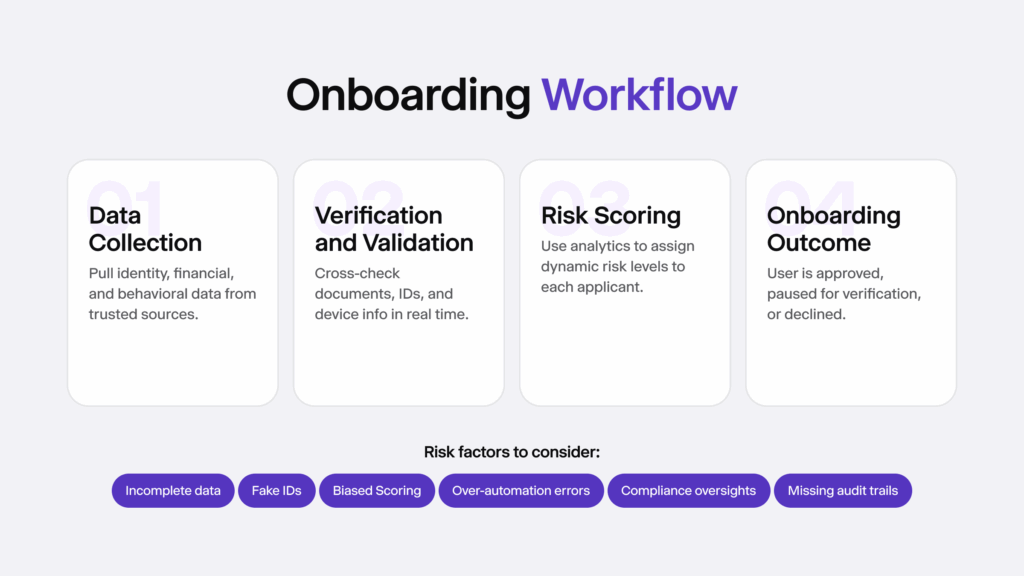
For banks, data is the first impression nowadays. When a new user applies for an account, takes out a loan, or requests credit, banks rely on digital signals to decide whether that person is trustworthy, solvent, and compliant. Nowadays, smart bank onboarding is more like a moment when user experience meets risk management – and where data is the difference between smart decisions and costly mistakes.
The best banks are not simply automating old processes. They are rethinking what onboarding means, using data as both a filter and a foundation for long-term relationships.
Why Data Has Become Central to Bank Onboarding
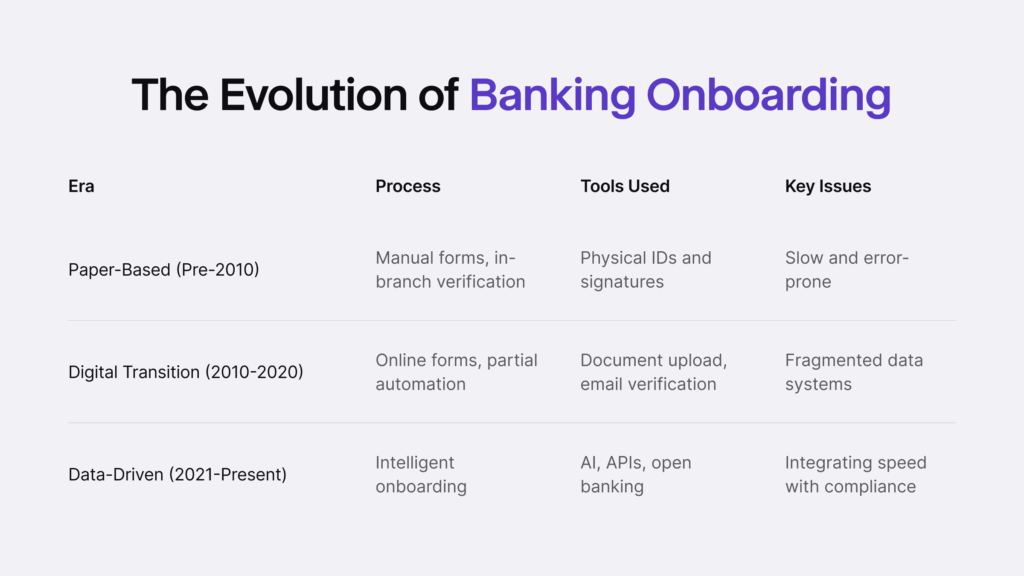
For decades, onboarding was mainly manual. Branch employees collected paper forms, reviewed IDs, and passed applications to compliance teams for background checks. It was slow, expensive, and full of human error.
That model does not work in a digital era where customers expect to open an account in minutes – not days. The shift to online banking forced financial institutions to reimagine how they evaluate risk without ever meeting a customer in person.
By combining identity data, behavioral analytics, credit insights, and compliance checks, banks now build a full picture of each applicant within seconds. The result is onboarding that is not only faster but smarter – where risk is not just managed but also predicted.
Automate your KYC process
iDenfy verifies customers from 200+ countries in seconds. AI-powered, compliant, and trusted by 1,000+ companies.
Explore KYC SolutionData as a Decision Engine
Data allows banks to move to a higher level of verification. Instead of simply confirming that a document looks real, they can understand who the customer is and how they behave financially.
Some of the most common data categories used include:
- Identity data: Government IDs, biometrics, device fingerprints, and IP addresses that establish the applicant’s identity.
- Financial data: Credit scores, transaction histories, and income patterns that help gauge risk and reliability.
- Behavioral data: Typing speed, device movement, and login frequency that can reveal potential fraud attempts.
- Open banking data: Direct account connections that show how a person or business manages funds in real time.
Instead of treating every applicant the same, banks can tailor smart bank onboarding decisions based on genuine context – approving low-risk customers quickly while flagging inconsistencies for further review, creating a dynamic risk profile.
Smarter Screening Through Predictive Analytics
One of the most significant advantages of data-driven smart bank onboarding is predictive capability, while traditional verification checks look backward – analyzing past transactions or known fraud patterns.
By feeding historical onboarding outcomes into machine learning models, banks can detect subtle correlations that humans might miss. For instance:
- A specific device type combined with a new IP address might correlate with synthetic identity fraud.
- Certain transaction sequences could signal a higher chance of account misuse.
- Behavioral deviations, like applying at unusual hours, may indicate risk even before the first transaction happens.
This predictive layer turns onboarding from a reactive process into a proactive one. Banks can act before fraud happens rather than after it is too late.
Related: Fraud Detection Using AI in Banking
How Data Personalizes the User Journey
Smart bank onboarding is also about creating a seamless experience and Quality of Life (QoL). Data allows banks to personalize the process to each user’s profile.
For example:
- Returning users can skip redundant steps if their verified data already exists in the system (and may be asked to update it if the data in the system is outdated).
- Low-risk applicants might enjoy instant approvals, while higher-risk ones are routed to enhanced verification workflows.
- Small businesses can receive onboarding flows that match their sector – for instance, fintech startups might trigger due diligence compared to low-risk service companies.
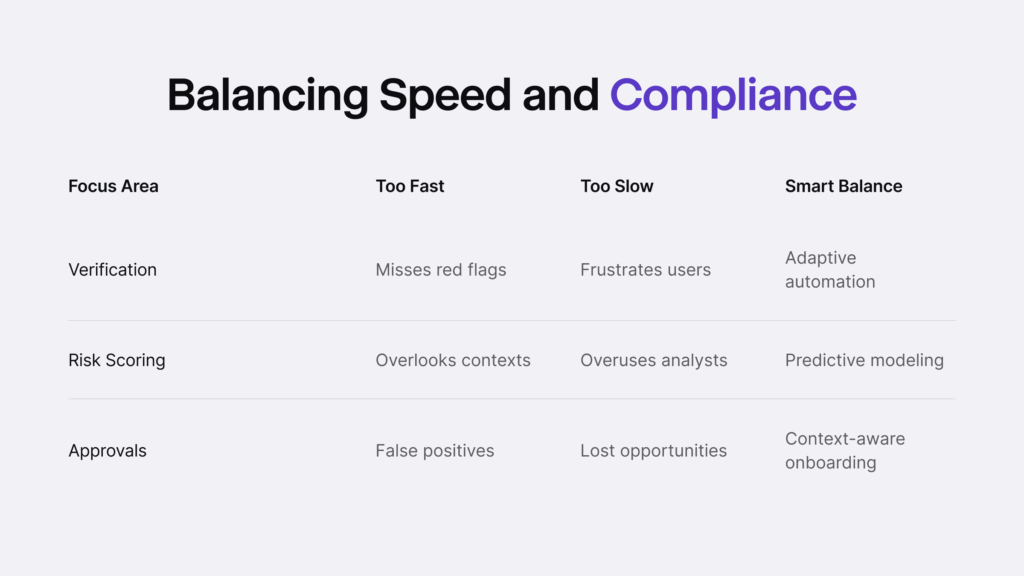
This kind of contextual onboarding makes users feel understood rather than processed. It reduces friction without compromising compliance – a balance that is increasingly becoming more difficult to achieve in regulated industries.
Speed and Security
Banks face a constant trade-off: please users by being fast, but stay cautious enough to satisfy regulators, therefore, data analytics helps close that gap.
Instead of relying on manual document review or broad assumptions, banks are able to use real-time data to make various decisions. Automated systems powered by AI flag only the cases that need human attention, allowing compliance officers to focus where they are most needed.
For instance, a bank might use an identity verification service that combines biometric checks with data analytics to validate both individuals and business entities instantly. This hybrid approach blends automation with oversight, helping institutions scale safely.
Data and the Rise of Collaborative Intelligence
One of the quiet revolutions happening in banking is the shift from isolated data to shared intelligence.
Banks increasingly participate in data-sharing networks that pool anonymized risk insights across institutions. When one bank detects a fraud pattern, others can learn from it almost instantly. This “collaborative intelligence” model strengthens the entire financial ecosystem, making it harder for fake individuals to exploit isolated gaps.
In practice, that might mean shared blacklists of known fraudulent identities, or cross-platform behavioral markers that flag unusual applications across different institutions. It is a powerful reminder that data is not just useful – it is communal.
Compliance and Data Science
Compliance teams used to be filtered from data teams. Now, the two work side by side.
Modern onboarding uses regulatory data – such as sanctions lists, PEP databases, and adverse media – alongside advanced analytics to surface risk patterns more quickly. Instead of checking names manually, algorithms continuously monitor new applicants against live data streams.
This approach has transformed how banks manage compliance workloads. Automated screening not only saves time but also reduces human bias and error. Regulators are beginning to recognize this shift too, encouraging banks to adopt data-driven systems that maintain accuracy and improve efficiency.
From Data to Trust
Behind every data point is a story. When banks analyze onboarding data effectively, they are not just protecting themselves from fraud – they are building a foundation of trust with customers.
A customer who experiences fast, transparent onboarding feels confident in the institution. A business that is vetted thoroughly but fairly sees the process as professional, not obstructive. Over time, this trust translates into loyalty.
It is worth noting that trust does not come from automation alone. Banks need to communicate clearly about how data is used and protected. Transparency around privacy policies, consent, and data handling reassures users that their information serves a legitimate purpose.
Issues of Data-Driven Onboarding
As promising as data-driven onboarding is, it is not without its challenges. Banks must have a careful balance between collecting enough information to make informed decisions and respecting privacy boundaries.
Data silos also remain a persistent issue. Different departments – from credit risk to compliance – often use separate systems, leading to duplicated work and missed insights. Integrating these data sources requires both technical capability and organizational buy-in.
Then there is the question of data ethics. As machine learning becomes central to onboarding, banks must ensure their algorithms remain explainable, fair, and free from bias. A “smart” onboarding system is not truly smart if it discriminates or makes opaque decisions.
What the Future of Smart Bank Onboarding Looks Like
In the coming years, data-driven onboarding will evolve from an innovation into an expectation. Customers already assume their bank can make fast, accurate decisions; behind the scenes, that will increasingly rely on smarter data.
We will see greater integration of real-time data streams – from open banking APIs to verified identity networks – feeding directly into onboarding engines. Predictive modeling will refine itself further, learning from every successful (or failed) onboarding attempt.
Meanwhile, regulators will likely demand more visibility into how banks make these automated decisions. Transparency and accountability will be just as important as speed and accuracy.
Ultimately, the banks that lead this transformation will be those that see onboarding not as a one-time transaction, but as the first step in a data-informed relationship – one that values insight as much as compliance.
Conclusion
Banking has always been about trust, but in today’s digital landscape, that trust begins with data. The institutions that learn to interpret, protect, and apply that data responsibly will make faster, fairer, and more confident onboarding decisions.
It is not just about preventing fraud or satisfying regulators. It is about understanding customers better – seeing more than just the form fields and behavior.
With tools like AI analytics, open banking integrations, and modern identity verification services, banks now have the ability to turn onboarding into a strategic advantage. The smarter the data, the stronger the trust – and in modern finance, trust is the ultimate currency.






 Try for free


