
B2B onboarding flows rarely get the attention it deserves, often treated as a procedural step – happening between closing a deal and starting work – onboarding is testing trust for the first time – the point where promises meet paperwork, where risk becomes real, and where both sides decide whether the relationship is built on solid ground.
Over the last few years, B2B onboarding has become notably more complex. Especially with increased regulatory expectations, business structures have become layered, and fraud has moved upstream into onboarding itself. At the same time, businesses are under pressure to move quickly. Deals are expected to close faster, partnerships to launch sooner, and delays are rarely tolerated.
Why Onboarding Feels More Complicated Than It Used To
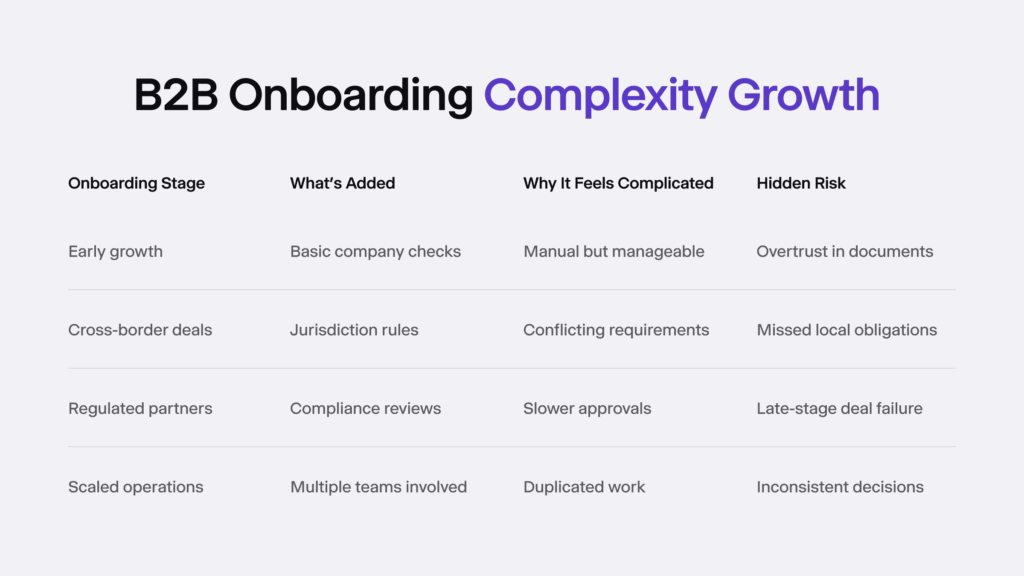
The complexity of B2B onboarding is not accidental, it is showing how business risk has changed, as companies are dealing with international suppliers, digital-first firms, holding companies, and entities that may operate across multiple jurisdictions.
Onboarding today often involves legal, compliance, operational, and commercial considerations simultaneously, with each team bringing its own requirements, and without coordination, those requirements pile up.
When onboarding is not designed intentionally, complexity grows organically – and usually in the wrong places.
What Can Go Wrong in Poorly Designed B2B Onboarding
When onboarding flows are not thought through, various issues show up quickly – sales teams start chasing approvals, compliance teams are sometimes taken into late-stage reviews, which would not look good in front of prospective partners who may lose patience after being asked for the same information multiple times.
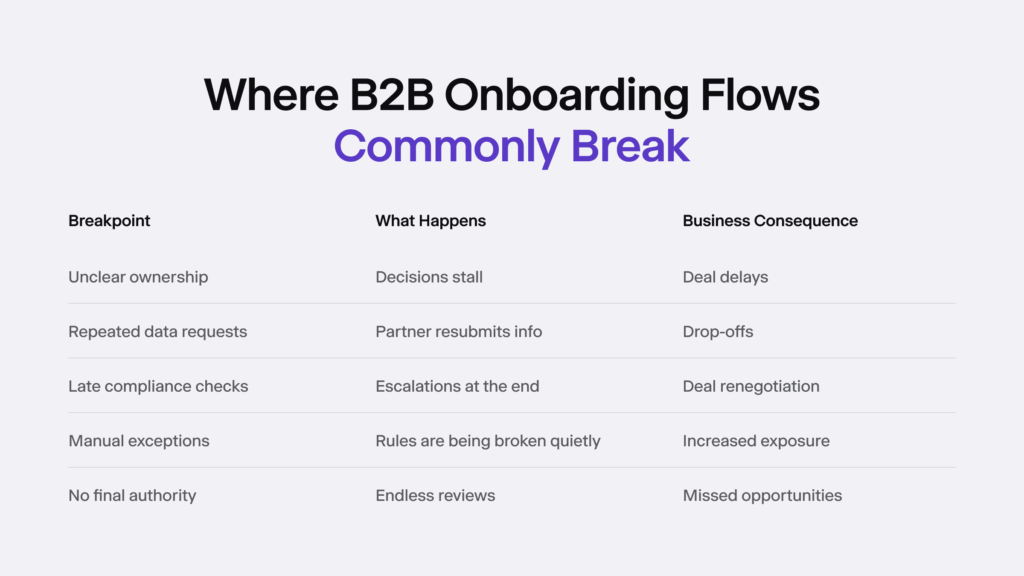
The most common issues tend to repeat:
- Unclear ownership of onboarding decisions
- Duplicated verification efforts
- Last-minute compliance escalations
- Inconsistent risk judgments
Teams adapt by creating informal workarounds, as onboarding stops protecting the business and starts increasing exposure.
Good onboarding builds confidence around a few core points, confirming that the business is real, that its structure makes sense, and that the people representing it are authorized to do so. Helping determine whether the risk involved is understood and acceptable is more important.
The idea of Know Your Business (KYB) becomes central here. Effective onboarding is mainly about understanding how the company is actually working and is aligning with the proposed relationship.
Why Non-Flexible Onboarding Models Do Not Hold Up
Many companies try to standardize onboarding by applying the same process to every partner. While consistency matters, rigidity usually does backfire in B2B environments.
A small professional services firm does not present the same risks as a multinational distributor, as forcing both through identical workflows either slows one down unnecessarily or fails to scrutinize the other properly.
More effective onboarding models allow for adjustment. Requirements change based on risk level, geography, or business type. The structure remains consistent, but the depth of review adapts to the situation.
Designing Flows That Support Decision-Making
Onboarding flows are designed around decisions, not tasks, as each step exists to support a specific judgment – escalation or rejection.
Well-structured onboarding typically follows a clear progression, confirming basic legitimacy, triggering more detailed reviews only when something requires closer attention, preventing teams from treating every case as high-risk, this way saving more time.
When onboarding is designed this way, delays are becoming intentional rather than accidental.
Speed Does Not Have to Compete With Anything
One of the biggest misconceptions in onboarding is that speed and thoroughness are opposites, having confusion mostly as the result of slow onboarding, not caution.
Clear sequencing helps resolve this tension, as some checks are essential before onboarding can proceed, while others can happen after activation. Separating what must happen now from what can happen later keeps onboarding without lowering standards.
This approach also makes expectations clearer for external partners, which reduces complexity.
Fewer Data Points, Better Outcomes
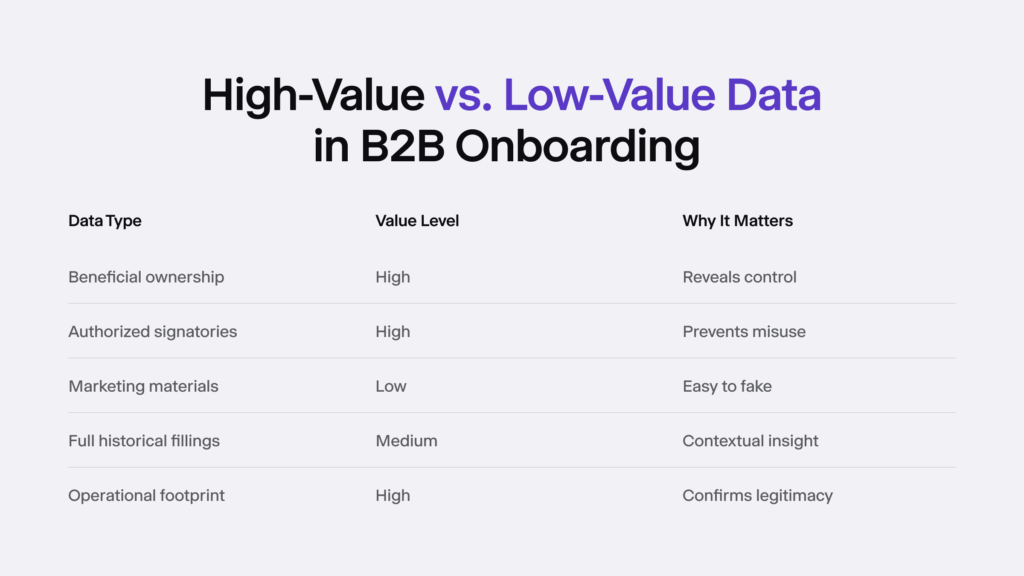
More information does not always lead to better decisions, as in onboarding, excessive data often creates noise and slows everything down.
The most effective onboarding processes focus on relevance – asking for information that actually contributes to understanding risk and legitimacy. When data requests are purposeful, partners are more willing to comply, and internal teams are better equipped to interpret what they receive.
Internal Alignment Is Often the Real Challenge
Many onboarding problems come from misalignment rather than missing tools. For example, sales and other teams often approach onboarding with different goals, so without clear ownership, decisions get delayed or revisited repeatedly.
Companies that handle onboarding well usually invest time upfront in defining:
- Who owns final approval
- When exceptions are allowed
- How disagreements are resolved
This clarity reduces complexity more effectively than adding new software or additional checks.
Technology Helps When Used With Intent
Automation has a significant importance in managing complex onboarding, especially as volumes grow, but technology works best when it supports human judgment.
Good systems show inconsistencies and document decisions clearly, as they do not attempt to eliminate reviews where context matters – a balance that keeps onboarding efficient without making any blind processes.
B2B onboarding is the first real interaction after a deal is agreed, signaling how a company handles risk and communication.
A chaotic onboarding experience can determine confidence early. A clear, fair, and well-structured one builds trust before the relationship even begins.
Conclusion
Mastering complex B2B onboarding flows does not require stripping them down to the bare minimum, requiring designing them with intention.
When onboarding reflects how businesses actually work and respects both risk and efficiency, it becomes a strength rather than a bottleneck.
Done well, onboarding does not slow growth. It makes growth sustainable.





 Try for free