Germany is often held up as a model of stability in Europe. The economy is disciplined, the legal system is methodical, the approach to regulation is deliberate, making the business verification very straightforward, yet for companies onboarding German businesses and other companies, KYB (Know Your Business) often feels more complicated than in neighboring markets – Germany’s KYB issue.
The main challenge lies in how business data is structured, how verification is traditionally handled, and how privacy expectations form the onboarding experience – many KYB frameworks are built for speed and scale, and struggle to adapt to an environment that values precision, documentation, and legal formality.
To understand Germany’s KYB issue, let’s look beyond compliance checklists and focus on how German businesses actually do the job.
Why Germany Does Not Fit the Standard KYB Model
Companies expanding into Europe often assume that once KYB works in one EU country, it can be replicated elsewhere with minimal changes, but Germany and possibly other countries quickly proves that assumption wrong.
German corporate structures have come a long way, even before digital onboarding was common – registries and disclosure rules were made for accuracy and legal certainty, not for fast API-based checks. Even though many systems are now digital, their logic remains in a slower, document-driven world.
As a result, KYB processes that rely on simplified assumptions – single registries, direct ownership, or instant updates – often fail the onboarding in Germany.
Complex Legal Forms Create Verification Gaps
First, Germany’s KYB issue is understanding the variety of business structures. Unlike other markets, where most companies fall into one or two familiar categories, Germany has a broad range of legal forms, each with its own rules around ownership, control, and representation.
For example, limited liability companies and hybrid structures may all appear similar at first glance, but they behave very differently from a verification standpoint. Authority to sign, ownership disclosure, and control may be split across multiple individuals or companies. Some roles are registered publicly, while others are not.
This complexity means that simply confirming a company’s existence is rarely enough, as here, effective KYB requires understanding how the structure functions in practice.
Accurate Data, Spread Across Systems
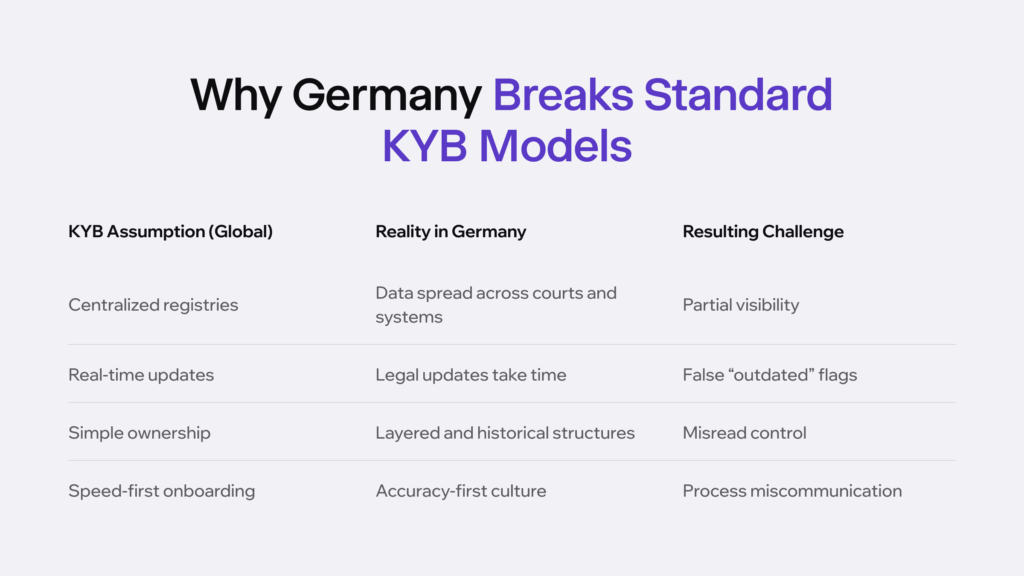
Germany’s business registries are generally reliable, but they are not centralized in the way many international teams expect – information is accurate, yet often distributed across different systems or regional authorities.
Updates may take time to appear, particularly when changes involve management roles or ownership adjustments. That does not make the data wrong – it just means it reflects a legal process rather than real-time business activity.
Beneficial Ownership Requires Interpretation
Germany follows EU requirements on beneficial ownership, but identifying the individuals who ultimately control a company can be interpretive. Ownership structures may involve holding companies, layered partnerships, or long-established family arrangements.
Registries and transparency databases do provide useful information, but they do not always tell the whole story, because a name on a list does not explain how decisions are made.
KYB transforms from a mechanical task to a contextual one, moving from retrieving data to assessing whether the structure makes sense for the type of business being onboarded.
Privacy Expectations Form the KYB Experience
Germany’s data protection approach influences how businesses respond to verification requests, and even when companies understand that KYB is required, they still expect clear insights for every requested data point.
Excessive explained verification steps can raise concerns rather than form trust. German businesses are less likely to accept low effort explanations or overly data collection, especially when personal details are involved.
Successful KYB processes in Germany tend to be transparent and proportional, explaining why information is needed and how long it will be kept, improving cooperation during onboarding.
Why Generic KYB Approaches Often Fall Short
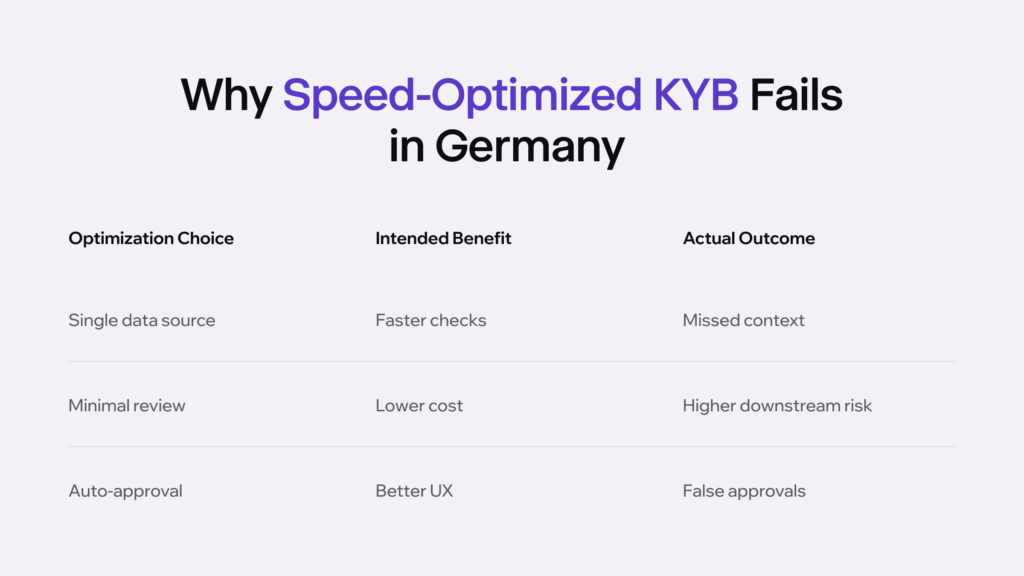
Many KYB systems are designed around speed, working well in markets with data that is centralized and simple ownership models. Germany challenges those assumptions.
Problems usually arise when:
- Registry data is treated as instantly current
- Ownership is assumed to be direct and obvious
- All businesses are pushed through the same workflow
In Germany, these shortcuts lead to delays or false confidence – neither outcome is ideal, especially in regulated industries.
Possible KYB Solution for the German Market
Solving Germany’s KYB issue means designing processes that reflect how German businesses actually operate.
The most effective KYB frameworks focus on consistency and interpretation rather than speed alone, together with registry data and document checks, cross-referencing multiple sources, and adapting workflows based on legal structure – here, the concept of know your business becomes practical – understanding the data already available and knowing when something does not align.
Trust in Germany is built through clarity, responding better to verification processes that are well-documented.
Well-managed KYB experience typically includes clear communication about requirements and verification steps that match risk levels.
When KYB feels structured rather than intrusive, businesses are more willing to engage fully and provide accurate information.
Technology Helps When Used Thoughtfully
Automation has a lot of importance in managing Germany’s KYB issue and complexity, but it must be used carefully, as systems need to account for different legal forms and allow for human review when various structures are possibly unclear.
The goal is not to eliminate judgment but to support it, as technology should handle repetitive checks and surface inconsistencies, and people should focus on interpretation and decision-making.
Effective KYB in Practice
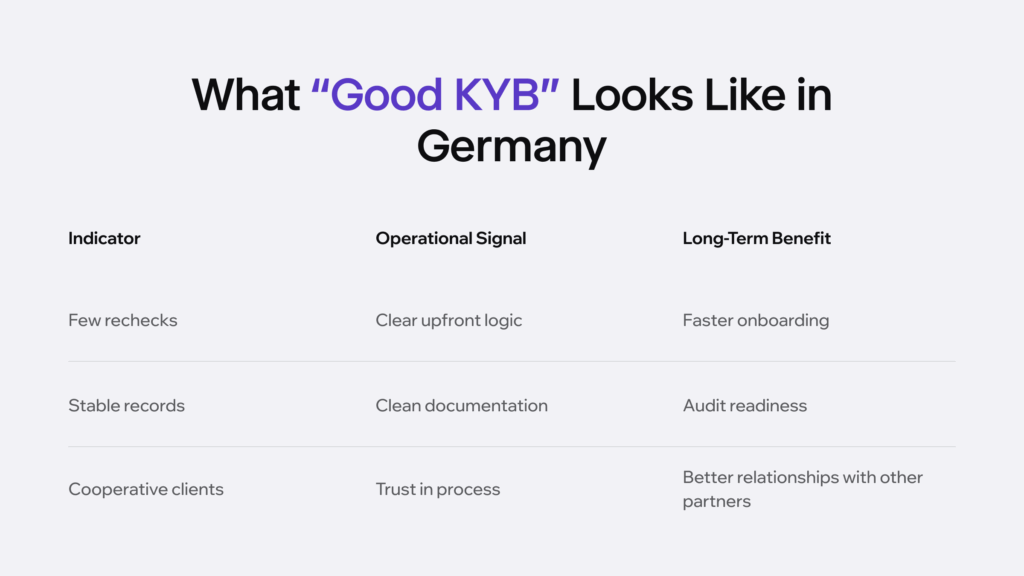
When KYB is working well in Germany, it goes unnoticed, and the onboarding moves at a steady pace. Questions are clear and justified. Documentation flows without repeated back-and-forth.
From an operational perspective, leading to fewer delays and long-term relationships that become stronger over time, preventing misunderstandings early – before they turn into regulatory or financial issues later.
Conclusion
Precision, structure, and a legal culture that values correctness over speed – companies that recognize this and adapt their approach are far more successful than those trying to force generic KYB models into a complex environment.
When KYB is designed with Germany’s realities in mind, it becomes more of a foundation. The effort invested upfront pays off in smoother operations, stronger trust, and lower risk over time.





 Try for free