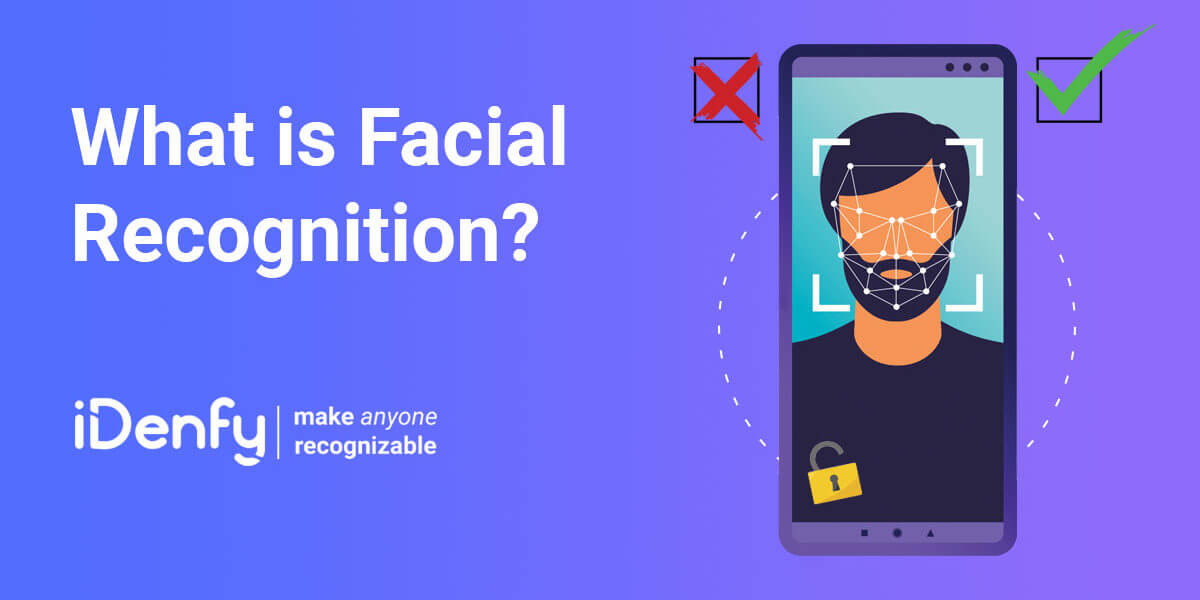
While the concept of facial recognition is not new, technological improvements have led to massive adoption. Today, you can see its usage everywhere: in passport offices to detect fraud in travel visas, in airports to screen passengers, in police stations to scan criminal data, or in banks to ensure the security of users.
In addition to this, some web applications, social networking websites, and smartphones also use this technology to prevent data misuse. Probably, your Smartphone also has a face recognition feature to unlock it. In addition, facial recognition technology has been used in various sectors and industries to prevent ID fraud and identity theft.
If you want to know more about facial recognition and how you can implement it into your business, keep on reading.
What is Facial Recognition?
Facial recognition technology captures and collects information from human faces to facilitate the process of identifying a person’s identity. In general, facial recognition captures, examines, and then compares a person’s facial details.
Facial recognition technology uses deep learning techniques through the utilization of neural networks. These networks can learn from vast amounts of data, sometimes in the millions, to decipher and draw conclusions. Consequently, the artificial intelligence (AI) model becomes adept at recognizing patterns within the encountered data points.
Related: Face Authentication: Why It Completes Your Identity Verification
The Importance of Facial Recognition in the Identity Verification Process
In the current scenario, when identity theft is widespread, facial recognition technology can significantly prevent identity fraud.
Facial recognition in identity verification or Know Your Customer (KYC) compliance is a process that uses automation and AI to remotely verify a person’s identity by comparing their live selfie (the biometric verification part) to their photo on an official ID (document verification), ensuring they are who they claim to be for secure, remote onboarding in finance and other regulated industries. Modern facial recognition solutions offer high accuracy and can match the unique characteristics of a human face. Businesses and organizations of different types can leverage this technology to minimize the risk of identity theft to a great extent.
There are various perks that reflect how facial recognition improves the whole KYC process. For example, it offers:
- Security. High accuracy with strong protection against fraud
- Convenience. Fully remote and contactless, as you only need a phone
- Speed. Automates KYC verification for near-instant onboarding, removing unnecessary friction that converts more users
- Compliance. Supports regulatory compliance with KYC or AML requirements, depending on other measures (when combined)
During the identity verification process, facial recognition analyzes characteristics such as the shape of the face, eye spacing, nose size, and other distinguishing features. It then generates a digital representation of these features, often called a facial template or faceprint. This template is compared against the templates stored in a secure database, such as government-issued identification documents or registered user profiles. If there is a match, the person’s identity is verified, and they are granted access to the desired service or platform.
Benefits of Biometric Facial Recognition Solutions
By incorporating facial recognition technology into identity verification, businesses reduce identity theft risk. This technology safeguards organizations from fraudulent activities, ensuring that only authorized individuals gain access to sensitive information, financial transactions, physical spaces, or digital platforms.
Here are the main benefits that facial recognition technology provides for businesses:
- Streamlined operations. Automated facial recognition systems enable businesses to streamline various processes, such as attendance tracking, access control, and customer identification, resulting in increased efficiency and productivity.
- Fraud prevention. By integrating facial recognition technology into payment systems or account access, businesses can mitigate the risk of fraud and identity theft, as it becomes significantly more challenging for impostors to impersonate someone else.
- Data-driven insights. Facial recognition systems can gather valuable data on customer demographics, behavior patterns, and preferences, providing businesses with insights to improve marketing strategies, optimize operations, and enhance customer satisfaction.
Related: What is Biometric Authentication? Definition, Examples, and Identity Verification Comparison
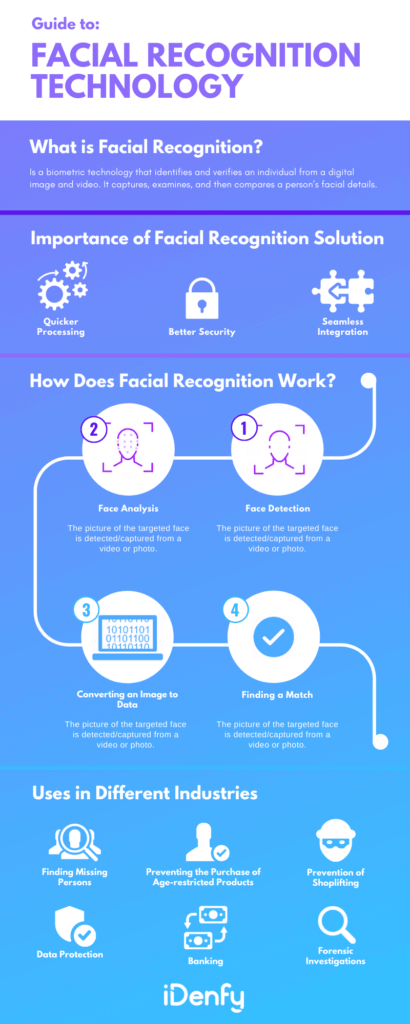
How Does Facial Recognition Work?
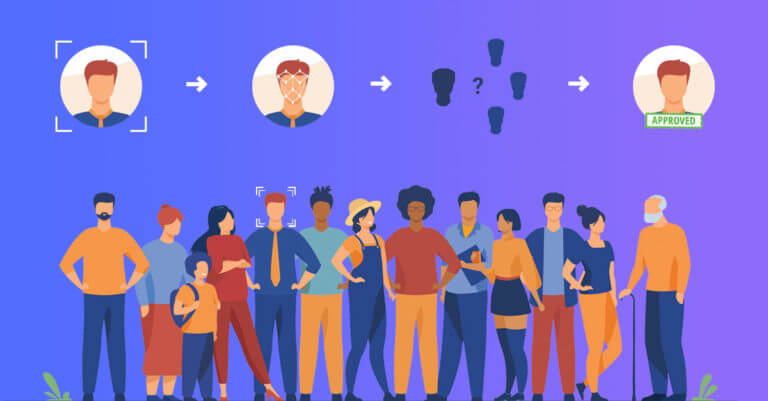
Here’s a simple step-by-step explanation of how facial recognition works:
- Capture. A camera or sensor captures an individual’s face, usually during an enrollment or authentication process.
- Detection. Facial recognition software identifies and locates the face in the captured image or video frame.
- Analysis. The software analyzes the facial features, such as the shape, size, and relative positions of the eyes, nose, mouth, and other unique characteristics.
- Faceprint creation. Based on the analysis, a digital representation of the face, called a faceprint, is created and stored securely in a database.
- Matching. During verification or identification, the captured face is compared against the stored faceprints in the database.
If there is a match, the person’s identity is confirmed during the verification process, or their identity is determined by finding a corresponding faceprint. The system can be integrated with access control systems, surveillance cameras, or payment systems to prevent unauthorized access and detect potential identity theft attempts.
Related: Identity Verification vs Identity Authentication: The Key Differences Explained
How Accurate is Facial Recognition Technology?
Can a face recognition system be fooled? A lot of people have this concern. Over the years, face recognition technology has improved considerably. The top identification algorithm has an error rate of only 0.8%. So we can say that in any condition, a facial recognition system can achieve an accuracy score as high as 99.97%.
How Criminals Try to Surpass Facial Recognition
Fraudsters are continually evolving their techniques to try to surpass facial recognition technology during the customer onboarding process.
Their objective is to create fraudulent accounts and bypass security measures. Here are a few common strategies they employ:
-
Presentation Attacks. Fraudsters attempt to trick facial recognition systems by using printed or digital images, masks, or even videos of the legitimate account holder. These attacks aim to deceive the system into recognizing the fake representation as a genuine face, allowing them to create fraudulent accounts.
-
Deepfakes. Deepfake technology enables fraudsters to create highly realistic videos or images that convincingly mimic someone’s face. By using deepfakes, they can attempt to deceive facial recognition systems by presenting a manipulated or synthetic face that closely resembles the target individual.
For businesses, that means incorporating multi-factor authentication, such as combining facial recognition with other biometric solutions or verification methods. Extra security measures provide help businesses mitigate the risk of fraudulent account creation. Regularly updating and improving facial recognition algorithms to stay ahead of emerging attack techniques is also crucial for maintaining a robust and secure customer onboarding process.
Related: Artificial Intelligence (AI) and Identity Theft: What it is and Why it Matters
Facial Recognition Technology Use Cases in Different Industries
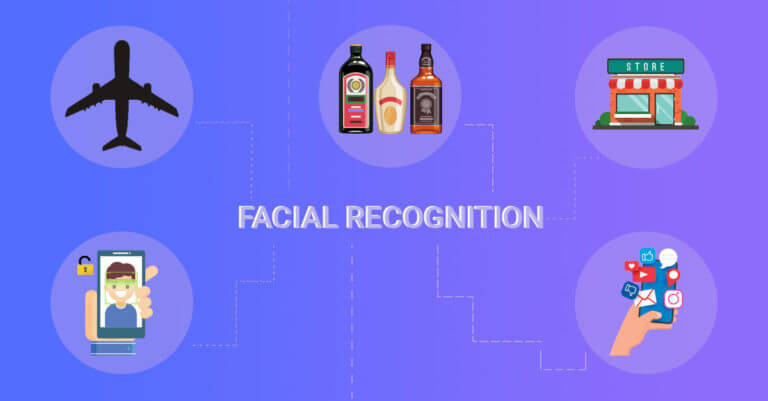
A biometric face recognition solution is used to identify and authenticate an individual with the help of verifiable data specific to that person. At present, facial recognition technology has been used in a variety of places and by a variety of industries.
Check out a few major examples below.
Finding Missing Persons
In many countries, face recognition technology is used to locate missing children and victims of human trafficking. If missing individuals are added to a database, it can be more comfortable for law enforcement agencies to recognize and find the missing people. In India, 3,000 missing children were traced in just four days using facial recognition technology.
Prevention of Shoplifting
shoplifting. Even Walmart confirms that they use an image recognition camera at checkout to detect shoplifting and other forms of fraud. Facial recognition systems can easily detect if any individual shoplifted any product from the store. They can even identify if the shoplifter has visited the store before.
Preventing the Purchase of Age-restricted Products
Some bars and wine shops in the United Kingdom use a facial recognition system to determine if the purchaser is of legal age to buy alcohol or other age-restricted products.
Banking
Some banks are using facial recognition to authenticate their customers. With the help of this technology, they’re helping their customers log in to their mobile banking apps securely. UK-based Lloyds bank also plans to bring such a feature using biometric identification technology.
Data Protection
Numerous mobile applications use face recognition technology to protect data. Such applications need your face to access private data.
Forensic Investigations
Face recognition solutions are also playing an essential role in forensic investigation. They can automatically identify individuals in security footage or other video recordings. The technology can even recognize dead or unconscious individuals at crime scenes.
Related: Top 5 Use Cases of Biometrics in Banking
The Bottom Line
When combined with technologies like machine learning and artificial intelligence, biometric facial recognition can give five times better results than human efforts. That makes facial recognition known for remarkably high accuracy rates, making it an ideal option for financial institutions when it comes to conducting identity verification.
At iDenfy, we offer facial recognition solutions powered by AI. No matter whether you need to verify the identity of your users/clients/customers physically or from a digital image or a video frame, our facial recognition will give you desired results.
Our facial recognition technology can analyze 160 plus face points within 0.5 seconds. That means you can verify hundreds of IDs within an hour. To learn more and get a free demo, feel free to book a meeting.
This blog post was updated on the 8th of January, 2026, to reflect the latest insights.







 Try for free